



ST. LOUIS, MO – November 25, 2026 (STL.News) Small businesses struggling across America are facing a stack of pressures at once: higher costs, tariffs, expensive credit, a shortage of qualified workers and, more recently, rising tax worries. At the same time, artificial intelligence has moved from experiment to everyday tool on Main Street. Most owners now use it in some form, yet only a small share have built it into how their business actually runs.
This article looks at the reasons for small businesses struggling in 2026, what the latest surveys show, and how AI is changing American small businesses, for better and for worse.
Small Businesses Struggling: The Big Picture
Small business confidence is soft but not collapsing. The National Federation of Independent Business (NFIB) said its Small Business Optimism Index slipped 0.1 point to 97.8 in October, the third straight monthly decline, leaving it just below its 53-year average of 98, according to TheStreet’s summary of the NFIB report. NFIB’s November report is due in December.
NFIB Chief Economist Bill Dunkelberg described October as a month with little change, as owners worked through problems that are not going away. The details of the survey show what those problems are.
1. Labor Quality Is Still the Top Problem
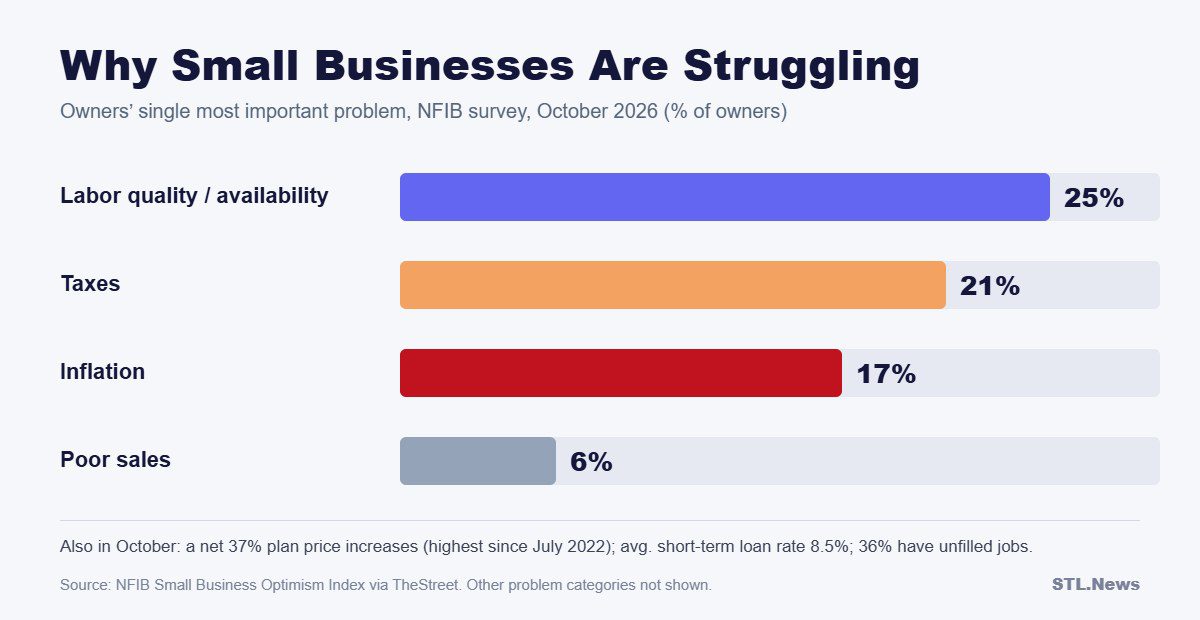
For the fourth month in a row, finding qualified workers ranked as owners’ single most important problem, cited by 25%. Some 36% of owners reported job openings they could not fill, the joint highest since March 2025. Small firms often cannot match the pay and benefits large companies offer, so open positions stay open longer.
2. Tax Worries Jumped
The share of owners naming taxes as their biggest problem jumped 10 points to 21% in October, the highest since May 2021. That moved taxes into second place, ahead of inflation.
3. Costs and Prices Keep Climbing
Inflation was the top problem for 17% of owners in October, down from the previous month but higher than a year earlier. A net 37% of owners plan to raise prices over the next three months, the most since July 2022. The U.S. Chamber of Commerce’s 2026 Empowering Small Business report found inflation was the top challenge for 32% of small businesses, up 9 points from 2025.
Health insurance is another fast-rising expense. Owners interviewed by CNN and CBS News have described rising health premiums squeezing their budgets alongside import costs.
4. Tariffs Hit the Smallest Firms Hardest
Tariffs have been one of the biggest reasons for small businesses struggling in 2026. According to a Federal Reserve survey reported by Fortune, 42% of small businesses said rising costs from tariffs were a primary financial challenge over the past year. Analysis of the same survey by the New York Fed found that firms facing greater tariff challenges were more pessimistic about their revenue and hiring in 2026.
The Supreme Court struck down most tariffs imposed under emergency powers in February 2026. Other tariffs, including Section 232 duties on steel and aluminum and Section 301 duties on Chinese goods, remain in place, and questions about refunds are still unresolved, according to Small Business Majority.
Small importers have limited room to adjust. They lack the buying power of big retailers, and many cannot easily switch suppliers or absorb costs. The Fed’s survey found many responded by raising prices, absorbing part of the cost themselves, or both.
5. Credit Is Expensive
Borrowing has become more costly. In NFIB’s October survey, a net 13% of regular borrowers paid a higher rate on their most recent loan, the most since August 2024, and the average short-term loan rate rose to 8.5%. For a business with thin margins, a few points of interest can decide whether a new truck, oven or hire is affordable.
6. Weaker Earnings and More Bankruptcies
Earnings trends fell to their weakest since March, with owners blaming weaker sales and rising material costs. Bankruptcy filings by small businesses rose 67% in the first quarter of 2026 compared with a year earlier, Marketplace reported.
Locally, St. Louis has its own examples of small businesses struggling. STL.News has tracked a string of St. Louis business closings, including long-running restaurants and retailers, and the closing of Straub’s Central West End store after 78 years.
7. Consumers Are Spending Differently
Shoppers are still spending, but more carefully. Restaurants and other service businesses are especially exposed when customers cut back, a trend STL.News examined in Why Are Americans Eating Out Less in 2026? Large retailers can absorb slower traffic for a while. A single-location shop often cannot.
How AI Is Changing American Small Businesses
For small businesses struggling with rising costs, AI offers a way to do more with the same staff. Adoption has grown fast:
- 76% of small businesses surveyed by Goldman Sachs 10,000 Small Businesses Voices in early 2026 said they use AI, and 93% of those users reported a positive effect.
- Half of small business workers now use AI on the job, mostly to be more productive rather than to replace people, according to the U.S. Chamber of Commerce Foundation’s Main Street AI Monitor.
- 66% of small and midsize businesses use AI, up from 55% a year earlier, in a survey by marketing platform Thryv reported by CPA Practice Advisor.
Survey numbers vary because they measure different things. Some count any use of a chatbot, while stricter government measures, such as the Census Bureau’s business survey, count only AI used to produce goods or services, which yields much lower figures.

Where Small Businesses Use AI Today
Most small business AI use is practical and everyday:
- Writing and marketing: drafting emails, social posts, product descriptions and ads.
- Customer service: chat assistants that answer common questions after hours.
- Bookkeeping and admin: sorting receipts, summarizing documents and preparing reports.
- Research and planning: brainstorming, pricing research and business plans.
- Video and design: turning photos into short promo clips and graphics.
The Chamber Foundation found 64% of worker AI users rely on it mainly for personal productivity tasks such as drafting, summarizing and brainstorming. For a hands-on example, STL.News tested AI video tools for a neighborhood bakery, hardware store and theatre.
Is AI Creating or Cutting Jobs?
So far, small business surveys point more toward job creation than job cuts. In the U.S. Chamber’s 2026 report, 25% of small businesses said AI is creating permanent jobs at their firm, compared with 6% that said it lets them reduce headcount, the Chamber said. In the Goldman Sachs survey, 87% said AI supports employees rather than replacing them.
These are self-reported survey results, often from business groups that promote technology use, so they are best read as early signals rather than final answers.
The AI Gap: Wide Use, Shallow Integration
The biggest finding across 2026 surveys is a gap between trying AI and getting full value from it.
- Only 14% of small businesses in the Goldman Sachs survey have fully integrated AI into core operations.
- 73% said more training and implementation resources would help, and 70% of owners in Thryv’s survey said they need more training.
- Firms with two to nine employees were significantly less likely to use AI than larger small businesses, the Chamber Foundation found.
- Common barriers include privacy and security concerns, uncertainty about how AI fits a specific business, and skills gaps.
That gap matters. The smallest businesses, the ones with the least time and money, stand to gain the most from automating routine work, but they are also the least likely to have the expertise to do it.
Practical Steps for Small Business Owners
For small businesses struggling to keep up with costs and new technology, a few low-risk steps stand out:
- Start with one task. Pick a repetitive job, such as answering common emails or writing social posts, and test an AI tool there first.
- Protect customer data. Avoid putting sensitive customer or financial information into free tools without checking their privacy terms.
- Check the output. AI tools make mistakes. Review anything that goes to customers or touches money.
- Use free training. Local Small Business Development Centers and the U.S. Small Business Administration offer guidance on technology, financing and planning.
- Review costs regularly. Track tariff-exposed inputs, loan rates and insurance renewals, and shop around before renewing.
What It Means for St. Louis and the Midwest
St. Louis has a large base of family-owned restaurants, shops and service firms that face the same pressures as businesses nationwide. Commercial real estate is shifting too, as seen in the Saint Louis Galleria land listing. For small businesses struggling in St. Louis, AI is unlikely to solve high costs or tariffs. It can, however, free up time and help small teams compete with larger chains on marketing and customer service.
Frequently Asked Questions
Why are small businesses struggling in 2026?
Small businesses struggling in 2026 most often cite a shortage of qualified workers, tax concerns, inflation, tariffs, higher borrowing costs and weaker earnings, according to NFIB and Federal Reserve surveys.
How many small businesses use AI?
Estimates range widely. Goldman Sachs found 76% of surveyed owners use AI, while stricter government measures show much lower rates of AI used directly in production.
Is AI replacing small business jobs?
Current surveys suggest AI is more often used to boost productivity. The U.S. Chamber found 25% of small businesses say AI is creating jobs, versus 6% using it to reduce headcount.
How can a small business start using AI?
Start with one repetitive task, protect customer data, review AI output and use free resources from the SBA and local Small Business Development Centers.
Sources and Further Reading
- TheStreet: NFIB Small Business Optimism Index, October 2026
- Goldman Sachs 10,000 Small Businesses Voices: AI survey, March 2026
- U.S. Chamber of Commerce Foundation: Main Street AI Monitor
- U.S. Chamber of Commerce: 2026 Empowering Small Business Report
- New York Fed, Liberty Street Economics: Effect of Tariffs on U.S. Small Businesses
- Fortune: Small businesses raising prices because of tariffs
- Marketplace: Small businesses are folding under tariff pressure
- CPA Practice Advisor: Thryv 2026 AI and Small Business Adoption Survey
Editorial note: Survey results come from different organizations using different methods and definitions of AI use, so figures are not directly comparable. Graphics in this article were produced by STL.News.