


Introduction to Laclede’s Landing
ST. LOUIS, MO – August 5, 2026 (STL.News) Few places in the Midwest tell the story of a city’s birth as completely as Laclede’s Landing. Long before St. Louis became known for the Gateway Arch, professional sports, brewing, or its role as one of America’s great transportation centers, the narrow stretch of land along the Mississippi River where Laclede’s Landing now stands served as the foundation upon which the city was built.
For more than 260 years, this neighborhood has witnessed nearly every major chapter in St. Louis history. French fur traders established a frontier settlement here in 1764. Steamboats later crowded the riverfront carrying immigrants, merchants, and goods destined for the expanding American frontier. Massive brick warehouses rose during the nineteenth century as St. Louis became one of the nation’s largest commercial cities. The district eventually fell into decline after World War II before being rediscovered through historic preservation efforts that transformed it into one of the Midwest’s most recognizable entertainment districts during the 1980s and 1990s.
Today, Laclede’s Landing is once again reinventing itself. Historic warehouses are being restored as apartments, offices, restaurants, and retail spaces. Public and private investment is reshaping the district into a mixed-use neighborhood designed to preserve its remarkable architectural heritage while creating a sustainable future.
Its story is not simply about buildings. It is the story of St. Louis itself.
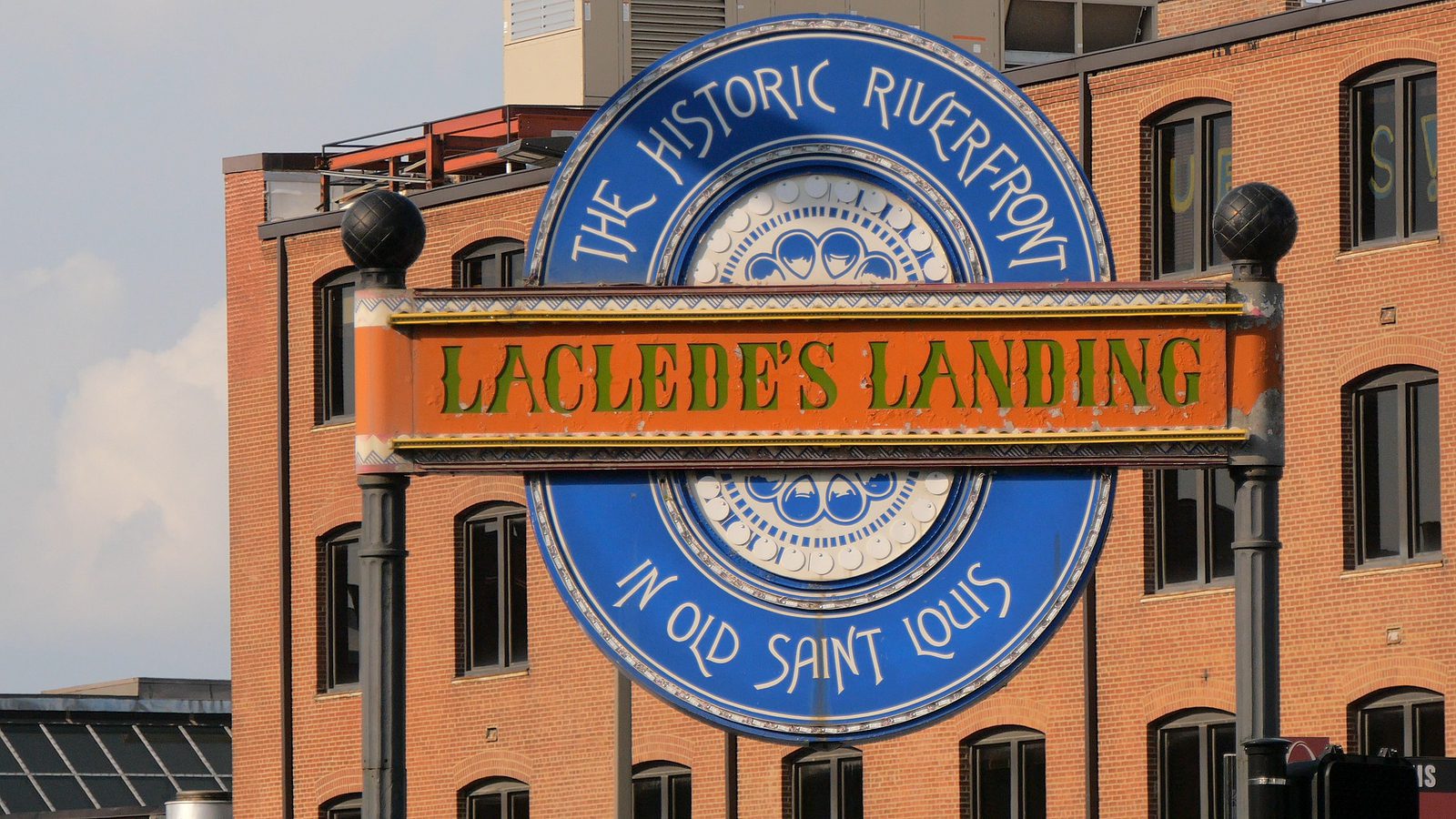
The Founding of St. Louis
The history of Laclede’s Landing begins decades before the United States existed.
During the eighteenth century, France controlled a vast territory stretching across much of central North America. This immense region, known as Louisiana, was connected by the Mississippi River and its tributaries, creating one of the world’s most important inland transportation networks.
French merchant Pierre Laclède Liguest arrived in the region seeking a location for a new fur trading post. Working alongside his young assistant, Auguste Chouteau, Laclède explored the western bank of the Mississippi River during the winter of 1763–1764.
He selected a limestone bluff overlooking the river for several practical reasons.
Unlike lower flood-prone areas, the elevated ground provided protection from seasonal flooding while maintaining direct access to river transportation. Dense forests supplied timber. Nearby prairies supported agriculture. The location sat near established Native American trade routes while offering excellent visibility along the Mississippi.
Laclède reportedly declared that the site was destined to become “one of the finest cities in America.”
Construction began in February 1764.
Although few could have imagined the city’s eventual growth, the decision permanently altered the history of the Mississippi Valley.
Every major period of St. Louis history can trace its roots to this location.
Why the Mississippi River Mattered
Modern visitors often admire the Mississippi River for its scenery.
To eighteenth-century traders, however, it represented something far more significant.
It was the interstate highway of its era.
Before railroads and automobiles, rivers determined where cities developed. Transporting goods by water was dramatically less expensive than moving freight over land. Canoes, keelboats, flatboats, and eventually steamboats carried enormous quantities of merchandise that would have required hundreds of wagons.
The Mississippi linked French settlements from Canada to the Gulf of Mexico.
As commerce expanded, St. Louis occupied one of the most advantageous positions on the continent.
Merchants could travel north toward present-day Minnesota, east into the Ohio River Valley, south toward New Orleans, or west through tributaries reaching the Great Plains.
The city’s geographic location transformed it into one of North America’s most important inland trading centers.
Without the Mississippi River, St. Louis almost certainly would not exist in its present form.
Without Laclede’s Landing, the riverfront economy that fueled the city’s early growth would never have developed.
A Frontier Trading Post Becomes a City
Life in early St. Louis revolved around commerce.
French traders exchanged manufactured goods for furs collected throughout the Mississippi Valley.
Pelts from beaver, deer, otter, fox, and other animals became valuable exports shipped to European markets.
Merchants established warehouses near the river.
- Blacksmiths opened shops.
- Carpenters built homes.
- Farmers supplied food.
- Religious institutions soon followed.
Although the settlement remained relatively small throughout its earliest decades, it attracted remarkable cultural diversity.
French settlers mixed with Spanish administrators after Louisiana was transferred to Spain in 1764.
Native American nations remained vital trading partners.
Later, American settlers arrived following the Louisiana Purchase in 1803.
Each wave of newcomers left its mark upon the city.
This multicultural heritage remains one of St. Louis’ defining characteristics.
The Louisiana Purchase Changed Everything
In 1803, the United States acquired the Louisiana Territory from France.
Few land purchases have altered American history more dramatically.
For St. Louis, the Louisiana Purchase transformed a frontier trading settlement into the gateway for western expansion.
- Government officials.
- Military expeditions.
- Surveyors.
- Explorers.
- Entrepreneurs.
All increasingly passed through the city.
One year later, Meriwether Lewis and William Clark departed from the St. Louis riverfront on their historic expedition to explore lands stretching toward the Pacific Ocean.
Although their exact departure point has been debated by historians, there is little question that the riverfront surrounding today’s Laclede’s Landing played an essential role in preparing and supplying the expedition.
The city’s strategic importance continued growing throughout the nineteenth century.
The Steamboat Revolution
Perhaps no development influenced Laclede’s Landing more than the arrival of steamboats.
Beginning in the early nineteenth century, steam-powered vessels revolutionized transportation throughout the Mississippi River system.
Unlike flatboats that drifted downstream, steamboats could travel both directions, dramatically increasing commercial efficiency.
By the mid-1800s, hundreds of steamboats regularly visited St. Louis.
The riverfront became an extraordinary scene of activity.
- Passengers disembarked carrying luggage.
- Dockworkers unloaded freight.
- Livestock moved through temporary holding areas.
- Merchants negotiated prices.
- River captains coordinated departures.
- Warehouses received shipments from every direction.
The sounds of whistles, engines, horses, wagons, and laborers filled the air from dawn until well after sunset.
The neighborhood that would become Laclede’s Landing functioned as one of America’s busiest inland commercial districts.
St. Louis Becomes a Commercial Giant
During the nineteenth century, St. Louis emerged as one of America’s largest cities.
By 1860, it ranked among the nation’s leading urban centers.
Its economy diversified rapidly.
- Flour mills.
- Breweries.
- Shoe manufacturers.
- Iron works.
- Machinery companies.
- Tobacco processors.
- Grain dealers.
- Wholesale distributors.
- Banks.
- Insurance companies.
Each industry depended upon transportation.
Laclede’s Landing became the logistical heart connecting these businesses to regional, national, and international markets.
Goods arriving by river were transferred to railroads.
Rail shipments returned to warehouses before continuing toward southern markets.
Few American cities enjoyed such extraordinary transportation advantages.
Building the Warehouse District
Many of the buildings visible today were constructed between the 1870s and the early twentieth century.
Developers designed them for durability rather than decoration alone.
Heavy masonry walls supported enormous floor loads.
Massive timber beams resisted fire better than lighter construction methods.
Large windows provided natural light before electricity became common.
Freight elevators connected multiple stories.
Wide loading doors accommodated wagons and later trucks.
Although each structure reflected the architectural preferences of its era, practicality remained the primary objective.
These buildings stored tremendous quantities of merchandise.
- Produce.
- Coffee.
- Sugar.
- Textiles.
- Hardware.
- Agricultural products.
- Manufactured goods.
Every floor contributed to the city’s commercial economy.
Remarkably, many survive more than a century later.
Architecture That Defines the Landing
Walking through Laclede’s Landing today reveals an architectural landscape unlike most American cities.
Italianate commercial buildings feature tall arched windows and decorative cornices.
Romanesque influences appear through heavy stone detailing and rounded arches.
Cast-iron storefronts once displayed merchandise to passing customers.
Brick façades demonstrate the craftsmanship of nineteenth-century masons.
Inside many buildings, exposed timber framing remains visible.
These enormous wooden beams often came from old-growth forests that no longer exist.
Their dimensions reflect construction practices impossible to duplicate economically today.
The famous cobblestone streets further distinguish the district.
Originally installed to withstand constant wagon traffic, the stones remain one of the neighborhood’s most recognizable visual features.
They remind visitors that this was once a working commercial district rather than a planned tourist attraction.
Railroads Expand the City’s Reach
While river transportation remained essential, railroads transformed commerce during the late nineteenth century.
The completion of Eads Bridge in 1874 permanently connected eastern and western rail networks across the Mississippi River.
At the time, it represented one of the greatest engineering achievements in the world.
Designed by James B. Eads, the bridge strengthened St. Louis’ position as a national transportation hub.
Freight could now move efficiently between railroads and riverboats.
Warehouses surrounding Laclede’s Landing benefited enormously from this intermodal transportation network.
The neighborhood became even more valuable to wholesalers distributing products throughout the Midwest.
Immigration Shaped the Neighborhood
Commerce attracted people from around the world.
German immigrants established breweries and manufacturing companies.
Irish laborers worked on railroads and construction projects.
Italian families opened businesses.
Eastern European immigrants contributed skilled trades.
African Americans, both before and after emancipation, played vital roles in river commerce, industry, transportation, and the city’s cultural development.
This diversity strengthened St. Louis economically while shaping neighborhoods throughout the city.
Laclede’s Landing reflected this multicultural heritage through the businesses operating within its buildings.
From Horses to Automobiles
- The twentieth century brought profound changes.
- Horse-drawn wagons gradually disappeared.
- Motor trucks became increasingly common.
- Road improvements altered transportation patterns.
- Electric lighting modernized commercial buildings.
- Telephones improved communication.
Although commerce remained strong for decades, gradual shifts were beginning.
River transportation no longer dominated freight movement as completely as it once had.
Manufacturing slowly dispersed.
Suburban industrial development emerged.
The neighborhood entered a period of transition.
The Long Decline Begins
Following World War II, many American downtowns experienced dramatic change.
- Federal highway construction encouraged suburban growth.
- Manufacturers relocated.
- Distribution centers moved closer to interstate highways.
- Modern warehouses required different layouts than nineteenth-century buildings could easily provide.
- Some historic commercial buildings became economically obsolete.
- Vacancies increased.
- Maintenance declined.
- Entire blocks throughout downtown St. Louis struggled.
Many cities demolished historic warehouse districts during this era in the name of urban renewal.
Laclede’s Landing narrowly escaped that fate.
Ironically, decades of underinvestment helped preserve many historic buildings because relatively few were replaced with modern construction.
That preservation would later become one of the neighborhood’s greatest strengths.
Saving a Neighborhood Before It Was Too Late
By the late 1950s and early 1960s, the future of Laclede’s Landing was anything but certain.
Across the United States, historic downtown neighborhoods were disappearing at an alarming rate. Urban renewal had become the dominant planning philosophy. Aging commercial districts were frequently labeled “obsolete” or “blighted,” and many cities responded by demolishing entire blocks of nineteenth-century buildings to make room for highways, parking lots, modern office towers, or public housing.
- St. Louis was no exception.
- Entire neighborhoods disappeared.
- Historic architecture that could never be replaced was reduced to rubble.
- Thousands of residents relocated.
Many city leaders believed modernization required clearing the past rather than preserving it.
The riverfront itself changed dramatically during the construction of what is now Gateway Arch National Park. Hundreds of historic structures south of Laclede’s Landing were demolished to create the Jefferson National Expansion Memorial. While the Arch would become one of America’s most recognizable monuments and a tremendous asset for tourism, the project also permanently altered the historic urban fabric of the original riverfront.
Ironically, Laclede’s Landing survived because it sat just north of the memorial grounds.
Instead of facing widespread demolition, many of its buildings simply remained vacant.
Although vacancy represented an economic challenge, it also meant the district retained much of its original nineteenth-century architecture.
What many viewed as neglected buildings would later become priceless assets.
The Rise of Historic Preservation
During the 1960s and early 1970s, attitudes toward historic preservation began changing throughout the United States.
Americans increasingly recognized that once historic buildings were demolished, they were gone forever.
Cities such as Boston, Philadelphia, Charleston, Savannah, New Orleans, and San Francisco demonstrated that historic districts could become economic engines rather than obstacles to development.
Developers in St. Louis began looking at the Landing through a different lens.
Instead of asking how quickly the warehouses could be replaced, they asked a different question:
“What if the history itself became the attraction?”
It was a revolutionary idea for its time.
Massive brick warehouses that once stored tobacco, coffee, machinery and wholesale merchandise suddenly offered something impossible to reproduce with new construction.
Authenticity.
Developers began restoring original brick walls instead of covering them with drywall.
Heavy timber beams became design features instead of structural obstacles.
Original windows were repaired.
Historic storefronts reopened.
Rather than hiding the age of the buildings, restoration celebrated it.
The Landing slowly became one of Missouri’s earliest large-scale examples of adaptive reuse—giving old buildings entirely new purposes while preserving their historic character.
A Different Kind of Neighborhood
By the mid-1970s, restaurants and specialty retailers slowly replaced warehouses.
- Art galleries appeared.
- Unique shops opened.
Visitors discovered that wandering through the cobblestone streets felt unlike anywhere else in metropolitan St. Louis.
- It was not suburban.
- It was not modern.
- It was historic.
People increasingly came simply to experience the atmosphere.
The neighborhood developed an identity that celebrated its industrial past while embracing contemporary entertainment.
Its authenticity became its greatest competitive advantage.
Unlike shopping centers designed around national chains, every building possessed its own story.
Every façade reflected different architectural styles.
Every block hinted at another chapter in the city’s commercial history.
The Nightlife Capital of St. Louis
By the early 1980s, Laclede’s Landing had evolved into something few people could have predicted two decades earlier.
It became the region’s premier nightlife destination.
For an entire generation of St. Louisans, simply saying “We’re going to the Landing tonight” required no further explanation.
Everyone knew exactly what it meant.
Friday evenings began with dinner at one of the neighborhood’s restaurants.
- Later came live music.
- Dance clubs.
- Pubs.
- Sports bars.
- Blues venues.
- Late-night food.
- Street musicians.
- Crowded sidewalks.
- Taxi cabs waiting for passengers.
- Lines stretching outside popular establishments.
- The Landing pulsed with energy.
Visitors came from every direction.
- St. Charles County.
- Jefferson County.
- Metro East communities in Illinois.
- Springfield.
- Columbia.
- Southern Illinois.
Convention guests staying downtown often spent their evenings exploring the Landing after business meetings concluded.
- Cardinals fans celebrated victories there.
- Concertgoers continued the evening after shows.
- Young professionals adopted the neighborhood as their social gathering place.
Long before smartphones and social media influenced nightlife, the Landing earned its reputation through word of mouth.
If someone wanted to experience downtown St. Louis after dark, there was no better destination.
A Weekend Tradition
Throughout the late 1980s and much of the 1990s, weekends at Laclede’s Landing became almost ritualistic for thousands of people.
- Parking lots filled before sunset.
- Restaurants developed waiting lists.
- Friends met beneath the glow of historic streetlights before deciding which venue to visit first.
- One establishment featured blues.
- Another hosted rock bands.
- Another specialized in jazz.
- Some emphasized dancing.
- Others offered quieter conversation inside beautifully restored brick buildings.
The variety itself became part of the attraction.
Visitors could easily spend an entire evening walking from one venue to another without ever moving their vehicle.
The compact nature of the district encouraged exploration.
Unlike suburban entertainment centers spread across multiple parking lots, the Landing rewarded walking.
Its narrow streets created a sense of discovery around every corner.
Why the Landing Became So Successful
Its popularity did not happen by accident.
Several factors converged at exactly the right time.
- Downtown St. Louis remained an important employment center.
- Convention business was strong.
- The Cardinals consistently attracted large crowds.
- Professional hockey and football increased downtown visitation.
The Landing offered something unique that suburban developments simply could not duplicate.
- History.
- Atmosphere.
- Walkability.
- Architecture.
- Authenticity.
Visitors were not simply going to dinner.
They were stepping into another era.
Exposed brick walls, original timber beams, gas-style street lamps and cobblestone streets created an environment that felt timeless.
That emotional connection became the district’s greatest asset.
Festivals and Celebrations
The Landing also became known for its annual events.
Holiday celebrations routinely attracted enormous crowds.
St. Patrick’s Day festivities became regional attractions.
Outdoor concerts filled the streets.
- Car shows.
- Food festivals.
- Riverfront celebrations.
- New Year’s Eve gatherings.
These events reinforced the Landing’s identity as downtown’s entertainment center while introducing new visitors to the neighborhood.
Many first-time guests returned later simply because they had discovered the district during a festival weekend.
Change Comes Again
No neighborhood remains frozen in time.
By the late 1990s, entertainment patterns throughout metropolitan St. Louis began changing.
Consumers increasingly sought destinations closer to home.
- New restaurant districts emerged.
- Suburban municipalities invested heavily in retail and entertainment developments.
- Casinos attracted significant leisure spending.
- Washington Avenue developed into another vibrant downtown district.
- Later, Ballpark Village fundamentally reshaped entertainment surrounding Busch Stadium.
Consumers suddenly had far more choices than they had during the Landing’s peak years.
Competition intensified.
Economic Challenges
Entertainment districts depend upon constant reinvestment.
As customer traffic declined, maintaining older buildings became increasingly expensive.
Historic structures require specialized restoration.
- Roof repairs.
- Masonry restoration.
- Window preservation.
- Mechanical upgrades.
- Accessibility improvements.
These costs often exceed those associated with newer construction.
- Some longtime businesses closed.
- Vacancies gradually increased.
- Empty storefronts reduced pedestrian activity.
- Reduced activity discouraged additional investment.
Like many historic downtown districts throughout America, the Landing entered a difficult cycle.
The Pandemic’s Impact
The COVID-19 pandemic accelerated many existing trends.
- Restaurants temporarily closed.
- Events disappeared.
- Convention business collapsed.
- Office workers shifted to remote employment.
- Downtown foot traffic fell dramatically.
Businesses dependent upon visitors faced unprecedented uncertainty.
Yet something interesting happened during the recovery.
Developers increasingly concluded that relying almost entirely upon nightlife created unnecessary vulnerability.
Instead, attention shifted toward creating a true neighborhood.
The New Vision
Today’s Laclede’s Landing is not attempting to recreate 1992.
Instead, developers are pursuing something arguably more sustainable.
- Mixed-use redevelopment.
- Historic warehouses are becoming apartments.
- Former commercial buildings now contain offices.
- Ground-floor retail continues expanding.
Restaurants remain essential, but they are increasingly supported by permanent residents rather than weekend crowds alone.
This represents a significant philosophical shift.
The objective is no longer creating a district that comes alive only after sunset.
The goal is creating a neighborhood active throughout the day.
- Morning coffee shops. (The Cobblestone STL)
- Lunch crowds.
- Office workers.
- Residents walking dogs.
- Tourists exploring history.
- Dinner guests.
- Evening entertainment.
Each supports the others.
Urban planners often describe this as creating a “24-hour neighborhood.”
Why Residential Growth Matters
Perhaps the single most important change occurring today is the increase in residential living.
For much of its history, relatively few people actually lived within the Landing.
Today, apartments occupy buildings that once stored freight.
Residents create steady demand for restaurants, grocery services, fitness facilities, retail shops, and neighborhood businesses.
Unlike visitors who arrive only on weekends, residents provide daily economic activity.
Successful downtown districts throughout America increasingly rely upon this balance.
Tourism alone cannot sustain a neighborhood.
Neither can nightlife by itself.
Long-term success requires people who call the neighborhood home.
Preserving the Past While Building the Future
One of the greatest achievements of the current revitalization is that it largely avoids replacing history.
Instead of demolishing nineteenth-century buildings, developers continue restoring them.
- Original brick remains visible.
- Historic façades survive.
- Heavy timber construction remains exposed.
- Modern plumbing, electrical systems, and elevators are carefully integrated without sacrificing architectural character.
- Adaptive reuse allows history to remain functional.
It proves that preservation and economic development are not opposing ideas.
They strengthen one another.
Laclede’s Landing – An Enduring Symbol of St. Louis
Laclede’s Landing has endured for more than two and a half centuries because it continually adapts while remaining true to its origins.
- It has been a frontier trading post.
- A commercial warehouse district.
- A transportation hub.
- An industrial center.
- A nightlife destination.
Today it is becoming a residential neighborhood once again connected to tourism, entertainment, dining, and commerce.
- Few places in Missouri have experienced so many reinventions while preserving so much of their original identity.
- Every restored building tells another chapter of the city’s story.
- Every new business demonstrates confidence in the future.
- Every resident adds life to streets that first welcomed settlers in 1764.
The Landing is more than a collection of historic buildings.
It is the place where St. Louis began.
Its continued preservation ensures future generations can experience—not merely read about—the birthplace of one of America’s great river cities.
As cranes rise above restored warehouses and new residents move into buildings once filled with barrels, crates, and freight, Laclede’s Landing is proving that history is not something left behind.
When properly preserved, history becomes the foundation upon which the future is built.
More Than an Entertainment District
Ask ten people what they remember most about Laclede’s Landing, and the answers will often depend upon their generation.
Someone who grew up during the 1980s will probably remember packed sidewalks, live music, restaurants, and late nights that stretched into the early morning hours.
Someone who visited during the nineteenth century would have remembered freight wagons, horses, warehouses, riverboats, and merchants unloading cargo from steamboats.
A tourist today may remember the cobblestone streets, historic architecture, views of the Mississippi River, and proximity to the Gateway Arch.
Each memory is accurate.
Each represents only one chapter in a history that spans more than 260 years.
The Landing has continually reinvented itself while remaining connected to its original purpose: bringing people together through commerce, transportation, hospitality, and culture.
Very few neighborhoods in America have evolved so dramatically without losing their historical identity.
Historic Buildings That Define Laclede’s Landing
One of the district’s greatest strengths is that visitors are not looking at reproductions.
Most of the buildings are authentic nineteenth-century commercial structures.
Although individual buildings have been renovated numerous times, many retain their original masonry, structural framing, window openings, and architectural character.
The neighborhood offers one of Missouri’s finest collections of warehouse architecture.
Several characteristics appear repeatedly throughout the district.
Brick Construction
The overwhelming majority of buildings use locally produced brick.
Brick was durable, readily available, relatively fire-resistant, and capable of supporting heavy warehouse loads.
Many exterior walls remain several bricks thick, helping regulate interior temperatures while supporting enormous structural weight.
Today these exposed brick walls have become one of the neighborhood’s defining architectural features.
Heavy Timber Framing
Before structural steel became common, warehouses relied upon massive timber beams and heavy wood columns.
Many of these beams were cut from old-growth forests that no longer exist.
Some timbers measure well over a foot in width.
Rather than concealing these structural members, modern renovations frequently expose them as architectural features.
They serve as visible reminders of nineteenth-century engineering and craftsmanship.
Freight Doors and Loading Areas
Many buildings originally featured oversized loading doors facing streets or alleys.
Merchants used these openings to move barrels, crates, machinery, and wholesale goods between wagons and upper floors.
Although today’s tenants use buildings differently, these historic openings often remain incorporated into modern storefronts.
Large Industrial Windows
Warehouses depended upon natural light.
Large windows reduced the need for artificial illumination while allowing workers to inspect merchandise.
Modern apartments and offices now benefit from these same oversized windows, which provide abundant daylight and views of the surrounding historic district.
Decorative Cornices
While warehouses emphasized function, many owners still invested in attractive architectural details.
- Pressed metal cornices.
- Stone lintels.
- Decorative brickwork.
- Arched windows.
These elements demonstrated commercial success while contributing to the visual character that continues attracting visitors today.
The Famous Cobblestone Streets
Perhaps no feature is photographed more often than the Landing’s cobblestone streets.
Unlike decorative paving installed in modern developments, these stones originally served a practical purpose.
Heavy wagons carrying freight constantly traveled through the district.
Cobblestones provided a durable surface capable of withstanding enormous weight while allowing relatively easy maintenance.
Although they created rough rides for horses and wagons, they proved remarkably durable.
Today they remain among the most recognizable reminders of nineteenth-century St. Louis.
They also provide visitors with an immediate sense that they have entered a historic environment unlike almost anywhere else in Missouri.
Businesses That Shaped the District
Throughout its history, Laclede’s Landing has supported a remarkable variety of businesses.
During the nineteenth century, visitors would have encountered:
- Wholesale grocers
- Grain merchants
- Produce distributors
- Hardware suppliers
- Tobacco companies
- Dry goods wholesalers
- Freight brokers
- Machinery dealers
- Coffee importers
- River transportation companies
By the late twentieth century, the district looked dramatically different.
Businesses increasingly focused upon hospitality.
- Restaurants.
- Irish pubs.
- Sports bars.
- Dance clubs.
- Blues clubs.
- Nightclubs.
- Comedy venues.
- Retail shops.
- Art galleries.
- Tourism services.
Today, another transition is underway.
Many restored buildings now include:
- Apartments
- Professional offices
- Technology companies
- Creative agencies
- Restaurants
- Coffee shops
- Boutique retail
- Event venues
- Hospitality businesses
This diversity helps strengthen the neighborhood by reducing dependence upon any single industry.
Transportation Through the Years
Transportation has always determined the Landing’s success.
1760s–1820s
Trade relied primarily upon canoes, keelboats, flatboats, and horseback transportation.
1820s–1880s
Steamboats transformed commerce, making St. Louis one of America’s busiest inland ports.
Late 1800s
Railroads expanded distribution throughout the Midwest.
The completion of Eads Bridge connected eastern and western rail systems while strengthening downtown’s economic importance.
Early 1900s
Motor trucks gradually supplemented horse-drawn wagons.
Warehouses adapted to changing freight systems.
Mid-Twentieth Century
Interstate highways shifted commercial activity toward suburban industrial parks.
Many traditional warehouses became obsolete.
Twenty-First Century
Public transit, tourism, residential living, pedestrian traffic, cycling, rideshare services, and nearby interstate access all contribute to the neighborhood’s accessibility.
Transportation has changed repeatedly.
The Landing has continually adapted.
Why Historic Preservation Matters
Historic preservation is often misunderstood.
- Some view preservation as preventing progress.
- Successful cities demonstrate exactly the opposite.
- Historic preservation creates economic value.
- Historic districts attract tourism.
- They support small businesses.
- They encourage walkability.
- They create unique residential environments.
They provide architectural diversity impossible to reproduce through modern construction.
Most importantly, preservation maintains a city’s identity.
If every historic building were replaced with contemporary structures, cities would increasingly resemble one another.
Laclede’s Landing remains distinctive precisely because it preserved so much of its original character.
Laclede’s Landing by the Numbers
While exact figures change over time, several facts illustrate the neighborhood’s significance.
- Founded as part of the original St. Louis settlement in 1764
- More than 260 years of continuous history
- Numerous nineteenth-century commercial buildings remain standing
- Located immediately north of Gateway Arch National Park
- Connected to downtown St. Louis by walking routes, MetroLink access, and major highways
- One of Missouri’s best-known historic entertainment districts
- Continues undergoing significant private and public investment through adaptive reuse and mixed-use redevelopment
Historical Timeline
1764
Pierre Laclède and Auguste Chouteau establish the settlement that becomes St. Louis.
1803
The Louisiana Purchase transfers the territory to the United States.
1804
The Lewis and Clark Expedition departs from the St. Louis riverfront to explore the newly acquired western territories.
1820s
Steamboat commerce accelerates growth throughout the Mississippi River Valley.
1850s
St. Louis emerges as one of America’s leading commercial cities.
Warehouse construction expands along the riverfront.
1874
Completion of Eads Bridge permanently changes transportation throughout the region.
Late 1800s
Wholesale trade reaches its peak.
Large brick warehouses dominate the neighborhood.
Early 1900s
Automobiles gradually supplement horse-drawn transportation.
Commercial activity remains strong.
1940s–1960s
Industrial restructuring, suburban development, and highway construction contribute to downtown decline.
Vacancies increase.
1960s
Construction of the Gateway Arch dramatically reshapes the riverfront.
Laclede’s Landing survives north of the memorial grounds.
1970s
Historic preservation efforts gain momentum.
Developers begin restoring warehouse buildings.
Restaurants and specialty businesses open.
1980s
Laclede’s Landing becomes one of the Midwest’s most recognizable nightlife destinations.
1990s
The entertainment district reaches its peak popularity, attracting visitors from throughout Missouri and Illinois.
Early 2000s
Competition from newer entertainment districts and changing consumer preferences contribute to declining visitation.
2020
The COVID-19 pandemic creates unprecedented challenges for restaurants, entertainment venues, and downtown businesses.
2020s
Major redevelopment efforts increasingly focus upon apartments, offices, restaurants, retail, and mixed-use neighborhood revitalization.
Frequently Asked Questions
Why is it called Laclede’s Landing?
The district is named after Pierre Laclède, the French fur trader who selected the site for the settlement of St. Louis in 1764.
Are the buildings original?
Many are authentic nineteenth-century commercial buildings that have been renovated and adapted for modern uses while preserving significant historic architectural features.
Why are the streets made of cobblestone?
Cobblestones provided durable surfaces capable of supporting heavy wagon traffic during the nineteenth century and remain one of the district’s defining characteristics.
Was Laclede’s Landing always an entertainment district?
No.
For most of its history, it functioned primarily as a commercial warehouse and wholesale distribution district.
Its reputation as a nightlife destination largely developed during the late twentieth century.
Why did the neighborhood decline?
Numerous factors contributed, including changing entertainment preferences, suburban competition, new downtown districts, economic cycles, infrastructure challenges, and later the effects of the COVID-19 pandemic.
What is happening today?
Current redevelopment emphasizes mixed-use development through historic preservation, residential apartments, offices, restaurants, retail businesses, tourism, and continued adaptive reuse of historic structures.
Looking Toward the Future
Every successful historic district eventually reaches a defining moment.
For Laclede’s Landing, that moment is now.
The neighborhood no longer depends exclusively upon nightlife.
Instead, it is becoming something far more resilient.
A place where people live.
- Work.
- Visit.
- Dine.
- Celebrate.
And experience the birthplace of St. Louis.
Its future success will depend upon preserving the authenticity that has always distinguished it while welcoming carefully planned investment that allows historic buildings to remain economically viable.
That balance has become the guiding principle of the district’s modern renaissance.
If achieved, Laclede’s Landing will continue telling the story of St. Louis for generations yet to come.
Conclusion
Cities rarely receive second chances.
Historic neighborhoods receive even fewer.
Laclede’s Landing has now experienced several lives.
It began as a frontier settlement overlooking the Mississippi River.
It evolved into one of America’s busiest warehouse districts.
It became the region’s premier entertainment destination during the late twentieth century.
It endured economic decline, changing consumer habits, and years of uncertainty.
Today, it stands at the beginning of another remarkable chapter.
Unlike many American cities that demolished large portions of their historic commercial districts, St. Louis retained one of its most authentic neighborhoods. That decision—whether intentional or simply the result of changing economic conditions—has given the city an irreplaceable asset.
As redevelopment continues, Laclede’s Landing offers something increasingly rare in modern America: a place where history is not confined to museums or monuments but remains woven into everyday life. Residents occupy former warehouses. Diners eat beneath century-old timber beams. Visitors walk streets that once echoed with horses, steamboat whistles, freight wagons, and merchants conducting business on the edge of the expanding American frontier.
For more than two and a half centuries, Laclede’s Landing has reflected the evolution of St. Louis itself. Its continued preservation ensures that future generations will not simply read about the city’s origins—they will be able to stand where those origins began.
More news articles that you might find interesting on STL.News:
- Laclede’s Landing Profile Page
- St. Louis Restaurant Review adds The Cobblestone STL to its Restaurant Directory
- Granite City, IL Issues 1,790 Red-Light Camera Citations
- Cahokia Heights Teachers Enter Second Year Without Contract
- St. Louis County Enters New Era With Executive Race
- Cahokia Heights, IL – Murder Suspect Cleveland J. Ware Arrested
- St. Louis County Prop U: What Voters Need to Know



