


Laclede’s Landing is experiencing one of the most significant revitalization efforts in its history. Millions of dollars in private and public investment have transformed historic warehouses into apartments, restored iconic buildings, and improved infrastructure throughout the district. As the neighborhood continues to attract new residents, business leaders see an opportunity for restaurants, retailers, professional services, and entrepreneurs to help shape the next chapter of one of St. Louis’ most historic communities.
ST. LOUIS, MO – August 6, 2026 (STL.News) – Every great city has a place where its story began.
For St. Louis, that place is Laclede’s Landing.
Long before towering office buildings defined the skyline, before Interstate highways crossed the region, and before professional sports stadiums drew millions of fans downtown, the Mississippi River served as the economic engine of an expanding nation. Along its western bank, warehouses lined the shoreline, steamboats unloaded cargo from across the country, merchants negotiated business deals, and entrepreneurs built fortunes that helped shape both St. Louis and the American Midwest.
More than 260 years after Pierre Laclède selected this stretch of riverfront as the site for a new trading post, Laclede’s Landing remains one of the city’s most recognizable neighborhoods. While the district has experienced periods of tremendous prosperity, economic decline, and reinvention, it is once again entering a period of transformation that many civic leaders, developers, and business owners believe could define its future for generations.
Unlike previous revitalization efforts centered primarily on nightlife and entertainment, today’s redevelopment focuses on something broader and potentially more sustainable: creating a true mixed-use urban neighborhood where people live, work, dine, shop, and gather every day of the week.
Over the past several years, historic buildings have been painstakingly restored, streets and sidewalks have been reconstructed, apartment communities have expanded, infrastructure has been modernized, and millions of dollars have been invested in preserving one of Missouri’s most important historic districts.
The physical transformation is easy to see.
The next challenge—and perhaps the greatest opportunity—is filling those beautifully restored buildings with businesses that will complete the neighborhood’s evolution.
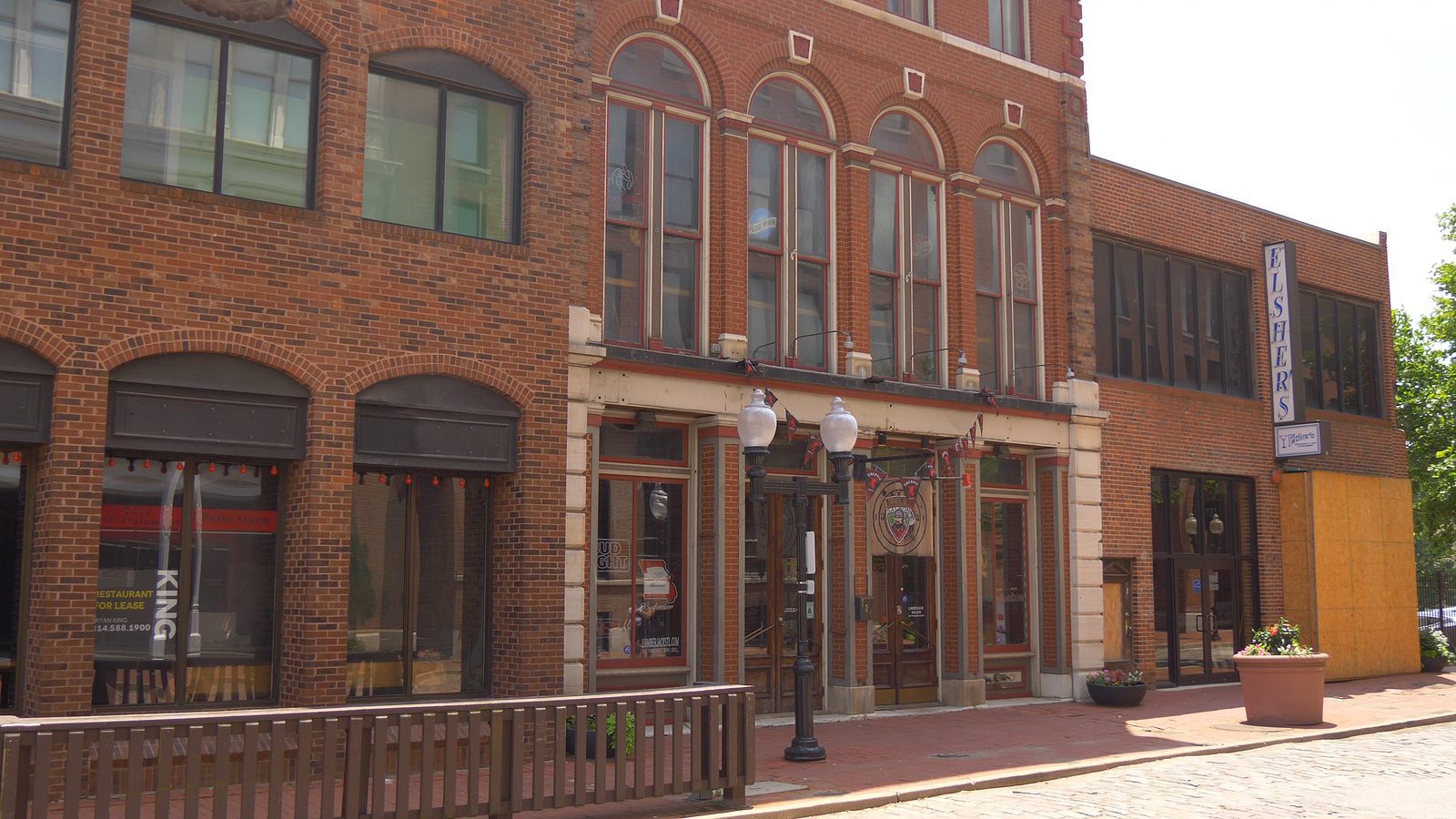
Laclede’s Landing is Where the Story of St. Louis Began
To understand why Laclede’s Landing remains so important today, it is necessary to look back to the city’s earliest days.
In February 1764, French fur trader Pierre Laclède, accompanied by his young assistant Auguste Chouteau, selected a high bluff overlooking the Mississippi River as the ideal location for a new settlement. The site offered protection from flooding while providing direct access to one of North America’s most important transportation corridors.
At the time, rivers served as the interstate highways of the continent.
Everything moved by water.
Furs traveled south toward New Orleans.
Manufactured goods traveled north.
Agricultural products moved throughout the Mississippi River system.
Merchants, explorers, settlers, and traders all depended upon the river.
St. Louis quickly became one of the most important commercial centers west of the Mississippi.
As commerce expanded during the nineteenth century, warehouses began replacing modest trading buildings along the riverfront. Brick structures rose several stories high, designed to store coffee, tobacco, whiskey, dry goods, produce, machinery, spices, hardware, and nearly every other commodity flowing through America’s interior.
The district bustled with activity from sunrise until sunset.
Steamboat whistles echoed across the river.
Horse-drawn wagons crowded narrow streets.
Laborers loaded freight destined for cities throughout the expanding nation.
Wholesale merchants established regional headquarters.
Banks financed commerce.
Insurance companies protected cargo.
Transportation firms coordinated shipments.
The Landing became the economic heartbeat of a rapidly growing city.
Many of the buildings standing today were constructed during this remarkable period of expansion.
Unlike modern commercial buildings designed for efficiency alone, these warehouses were built to last generations. Massive timber beams supported heavy cargo. Thick brick walls insulated valuable merchandise. Decorative cast-iron storefronts reflected the prosperity of their owners while providing durable commercial space.
More than a century later, those same architectural features have become one of the neighborhood’s greatest assets.
Laclede’s Landing has Survived an Era of Demolition
The twentieth century brought dramatic change.
Railroads gradually replaced much of the river traffic that had fueled the Landing’s prosperity. Eventually, interstate highways and trucking transformed commercial transportation once again.
Warehouse districts throughout America faced similar challenges.
Businesses relocated.
Freight terminals moved.
Older buildings became increasingly expensive to maintain.
Across the country, historic commercial neighborhoods were demolished in favor of parking lots, highways, and modern office towers.
St. Louis was no exception.
During the era of urban renewal, countless historic buildings throughout downtown disappeared.
Fortunately, local preservation advocates recognized the extraordinary historical significance of Laclede’s Landing before it was too late.
Community leaders, historians, architects, preservation organizations, and city officials worked together to protect the neighborhood’s remaining historic structures.
Their efforts resulted in federal historic recognition and established Laclede’s Landing as one of the country’s best-preserved nineteenth-century commercial districts.
That decision continues to benefit St. Louis today.
Had preservation advocates failed, the city would almost certainly have lost one of its most authentic historic neighborhoods forever.
Laclede’s Landing – Reinvention Through Entertainment
Saving the buildings, however, was only the beginning.
Historic districts must remain economically viable if preservation efforts are to succeed over the long term.
During the 1970s and accelerating through the 1980s and 1990s, Laclede’s Landing experienced another remarkable transformation.
Former warehouses became restaurants.
Industrial buildings evolved into breweries.
Nightclubs occupied spaces once filled with freight and merchandise.
Music venues brought nationally recognized performers to downtown St. Louis.
For an entire generation, the Landing became synonymous with nightlife.
Friday and Saturday evenings brought thousands of visitors onto the district’s cobblestone streets.
Restaurants stayed busy late into the evening.
Patios filled with customers.
Live music echoed through historic buildings.
The neighborhood developed a personality unlike anywhere else in the metropolitan area.
Mississippi Nights became one of the country’s best-known live music venues, hosting artists ranging from emerging local performers to internationally recognized acts.
Morgan Street Brewery helped introduce many St. Louis residents to the growing craft beer movement long before local breweries became commonplace.
Independent restaurants gave visitors reasons to return again and again.
The Landing was not simply a collection of businesses.
It became an experience.
People celebrated birthdays there.
Couples had first dates there.
Friends gathered after Cardinals games.
Visitors from around the country discovered a side of St. Louis that combined history, architecture, entertainment, and riverfront scenery unlike any other Midwestern city.
For many longtime residents, memories of Laclede’s Landing remain deeply personal.
Changing Consumer Habits
Like many entertainment districts across America, however, the Landing eventually faced new challenges.
Consumer preferences evolved.
Suburban entertainment centers expanded.
New restaurant districts emerged throughout the metropolitan area.
Casinos introduced additional competition for nightlife dollars.
Later, Ballpark Village became another significant entertainment destination downtown.
At the same time, downtown St. Louis experienced decades of declining residential population.
Fewer people lived within walking distance.
Many office workers left downtown at the end of each business day.
Weekend visitation remained important, but weekday activity became increasingly difficult to sustain.
Some long-established businesses closed.
Vacancies increased.
Deferred maintenance became more noticeable.
Then came the COVID-19 pandemic.
Restaurants, bars, entertainment venues, hotels, and tourism businesses throughout the country faced unprecedented disruption.
Laclede’s Landing was no exception.
Yet beneath those challenges, something important was already beginning to happen.
Developers and city leaders increasingly recognized that the district’s future did not necessarily depend on recreating the nightlife of the 1990s.
Instead, they saw an opportunity to build something that many successful urban neighborhoods already possessed—a balanced community where housing, restaurants, retail, hospitality, offices, and public spaces support one another throughout the week.
That vision would require significant investment.
It would also require patience.
Historic preservation is rarely fast, inexpensive, or easy.
But for developers willing to undertake the challenge, Laclede’s Landing offered something increasingly rare in American cities: an authentic historic district with remarkable architecture, walkable streets, riverfront access, and a location surrounded by many of St. Louis’ most important attractions.
A Long-Term Vision Begins to Take Shape at Laclede’s Landing
Among the companies helping lead that transformation is Advantes Group, whose investment strategy has focused on restoring—not replacing—the neighborhood’s historic buildings.
Rather than viewing aging warehouses as obsolete properties, the company recognized the opportunity to preserve the craftsmanship of the nineteenth century while adapting those buildings for twenty-first century living.
That philosophy has become one of the defining characteristics of the Landing’s modern redevelopment.
Instead of demolition, buildings have been rehabilitated.
Instead of vacant upper floors, apartments have welcomed new residents.
Instead of abandoned storefronts, developers have created opportunities for future restaurants, retailers, cafés, offices, and neighborhood services.
The work has not been limited to cosmetic improvements.
Historic masonry has been repaired.
Structural systems have been reinforced.
Modern utilities have been installed.
Historic architectural details have been preserved whenever possible.
Original timber beams, exposed brick walls, oversized industrial windows, and soaring ceilings—features once valued simply for their practicality—have become some of the most desirable elements of contemporary urban living.
Those investments represent more than attractive real estate projects.
They demonstrate confidence in the future of downtown St. Louis and in the enduring value of one of America’s oldest commercial districts.
Historic Buildings Become Modern Homes at Laclede’s Landing
The most visible sign of Laclede’s Landing’s resurgence is not found in a single building. Instead, it can be seen throughout the district as one historic warehouse after another has been restored and returned to productive use.
For decades, many of these buildings stood largely vacant. While their architectural character remained intact, years of deferred maintenance and changing commercial patterns left many without a practical purpose. Redeveloping them required far more than cosmetic renovations. It demanded a long-term commitment to preserving history while adapting each structure to meet the expectations of modern residents and businesses.
That process has become one of the defining achievements of the Landing’s recent revitalization.
Rather than demolishing historic structures to make way for new construction, developers embraced adaptive reuse—a preservation strategy that restores existing buildings while modernizing their interiors for contemporary use.
Today, visitors walking through the district will notice beautifully restored brick facades, original timber beams, large industrial windows, decorative cast-iron storefronts, and carefully preserved architectural details that connect today’s neighborhood with its nineteenth-century roots.
Inside those buildings, however, are modern apartments featuring updated kitchens, contemporary finishes, high-speed internet, fitness amenities, secure access, and conveniences expected by today’s residents.
The result is a neighborhood where history and modern urban living coexist naturally.
The Vision Behind the Redevelopment at Laclede’s Landing
Among the most active participants in that transformation has been Advantes Group, a St. Louis-based real estate investment and development company whose philosophy differs from traditional urban redevelopment.
Rather than clearing blocks for large-scale new construction, the company has concentrated on preserving historic properties that contribute to the character of downtown St. Louis.
Over several years, Advantes assembled a portfolio of buildings throughout Laclede’s Landing, many of which had been vacant or underutilized for decades.
The company’s redevelopment strategy recognized something that preservationists have long understood: historic architecture is an economic asset.
Across the United States, neighborhoods with authentic historic character consistently attract residents, visitors, restaurants, boutique retailers, and creative businesses seeking environments that cannot be replicated through modern construction.
Laclede’s Landing possesses that authenticity in abundance.
The narrow streets, massive brick warehouses, exposed stone foundations, cast-iron storefronts, and proximity to the Mississippi River create an atmosphere found in very few American cities.
Rather than attempting to modernize away those characteristics, developers have embraced them.
Preserving the Character of Laclede’s Landing
Historic preservation is often misunderstood.
Many assume restoring an older building simply involves cleaning brick and repainting walls.
In reality, rehabilitating nineteenth-century commercial structures is among the most complex forms of real estate development.
Every building presents unique engineering challenges.
Original foundations must be stabilized.
Historic masonry often requires extensive restoration.
Wood framing must be evaluated carefully.
Modern electrical, plumbing, heating, cooling, sprinkler, and communications systems must be integrated without compromising historic features.
Accessibility improvements must comply with current building codes while respecting architectural integrity.
These projects often take years to complete.
The finished product reflects thousands of hours of planning, design, engineering, craftsmanship, and construction.
That commitment is evident throughout Laclede’s Landing today.
Laclede’s Landing – A Collection of Landmark Properties
Several redevelopment projects have become anchors of the district’s resurgence.
Peper Lofts transformed a historic warehouse once associated with the region’s tobacco industry into attractive residential apartments while preserving the building’s distinctive industrial architecture.
Paincourt Lofts restored another significant commercial building whose masonry details and historic façade continue to define the streetscape.
Old Judge Lofts, named after the well-known coffee and spice brand once associated with the property, represents another successful example of adaptive reuse, allowing residents to live inside a building that once played an important role in the city’s wholesale economy.
Greeley Lofts, Hoffman Lofts, Trader Lofts, and additional restored buildings continue that pattern throughout the neighborhood.
Each project tells a different story.
One building once stored produce shipped from across the Midwest.
Another served wholesale merchants supplying retailers throughout the region.
Others handled coffee imports, tobacco products, or industrial goods moving along the Mississippi River.
Rather than allowing those stories to disappear, redevelopment has preserved them as part of the neighborhood’s identity.
Collectively, these projects have added hundreds of residential units while maintaining the historic streetscape that distinguishes Laclede’s Landing from newer developments elsewhere in the city.
Laclede’s Landing – Creating a Neighborhood Rather Than a Destination
Perhaps the most significant change occurring in the Landing is philosophical.
For decades, the district was largely viewed as a destination.
People drove downtown for dinner, concerts, or nightlife before returning home elsewhere in the metropolitan area.
Today’s redevelopment reflects a different vision.
The Landing is becoming a neighborhood.
That distinction matters.
Neighborhoods support grocery stores.
Coffee shops. (The Cobblestone STL)
Dry cleaners.
Fitness studios.
Medical offices.
Neighborhood restaurants.
Pet services.
Professional offices.
Walkable retail.
Community gathering spaces.
Unlike entertainment districts that remain active primarily in the evenings and on weekends, mixed-use neighborhoods generate activity throughout the day.
Residents walk dogs in the morning.
People stop for coffee before work.
Remote workers meet clients over lunch.
Neighbors dine together in the evening.
Weekend visitors discover locally owned businesses.
That continuous activity creates a healthier economic environment for businesses while also improving public safety through increased pedestrian traffic.
Laclede’s Landing – Public Investment Reinforces Private Development
Public investment has supported private redevelopment throughout the district.
The City of St. Louis, working alongside other public agencies and stakeholders, has invested in infrastructure improvements designed to strengthen the Landing’s long-term appeal.
Visitors today immediately notice upgraded lighting that improves both visibility and aesthetics.
New sidewalks enhance walkability.
Landscaping softens public spaces while creating a more inviting pedestrian environment.
Utility improvements have modernized essential infrastructure hidden beneath the streets.
Additional public safety measures have also contributed to creating an environment where residents and visitors feel more comfortable exploring the neighborhood.
The streets themselves have undergone significant reconstruction.
While preserving the district’s historic character remained an important priority, improvements have made the area more accessible for pedestrians, cyclists, residents, and visitors alike.
These public investments represent more than maintenance.
They signal confidence in the neighborhood’s future.
Cities rarely invest heavily in districts they consider temporary.
The continued commitment to Laclede’s Landing reflects its importance as both a historic resource and an economic development priority.
Laclede’s Landing – A Strategic Location Unlike Any Other
Location has always been one of the Landing’s greatest strengths.
Few neighborhoods in the Midwest enjoy such extraordinary proximity to major attractions.
Within only a few minutes’ walk are Gateway Arch National Park, the Mississippi Riverfront, Busch Stadium, Ballpark Village, America’s Center Convention Complex, the Dome at America’s Center, the Four Seasons Hotel, Horseshoe St. Louis, MetroLink stations, and downtown’s growing residential core.
During Cardinals home games, conventions, concerts, festivals, and major civic events, hundreds of thousands of people pass within walking distance of the district.
Those visitors already come downtown.
The opportunity lies in encouraging them to spend additional time exploring Laclede’s Landing.
Cities across the country invest millions in creating destinations that attract visitors.
The Landing already benefits from being surrounded by destinations.
The challenge is strengthening the connections between those attractions and the neighborhood’s growing collection of businesses.
Residential Growth Changes the Equation at Laclede’s Landing
Urban economists often describe residential population as the foundation of successful mixed-use districts.
Visitors provide important revenue.
Residents provide stability.
People who live in a neighborhood purchase groceries every week.
They buy coffee several times each week.
They dine locally.
They seek healthcare providers.
They exercise.
They visit salons.
They purchase gifts.
They meet friends after work.
They support neighborhood businesses regardless of whether a baseball game or convention happens to be taking place nearby.
That dependable customer base creates opportunities for entrepreneurs that simply did not exist when the Landing functioned primarily as a weekend entertainment district.
As additional apartment projects reach completion and occupancy continues to grow, demand for neighborhood-oriented businesses is expected to increase accordingly.
That creates one of the most promising opportunities in the district’s modern history.
Why Entrepreneurs Should Look at Laclede’s Landing
Every successful neighborhood reaches a turning point.
The buildings have been restored.
The infrastructure has been modernized.
Residents begin moving in.
Public confidence returns.
Eventually, the next phase belongs to entrepreneurs.
Many urban planners describe this point as the transition from redevelopment to activation. The buildings are no longer the story. The businesses, people, and experiences become the story.
Laclede’s Landing appears to be approaching that stage.
The district already possesses many of the qualities business owners spend years searching for.
It offers a recognizable identity.
It has authentic architecture.
It is surrounded by major attractions.
It is increasingly populated by residents who want neighborhood amenities within walking distance.
Unlike a newly constructed shopping center, the Landing offers businesses an opportunity to become part of a place with genuine history and character.
Customers often seek experiences that cannot be duplicated online or in suburban commercial developments.
Historic neighborhoods naturally create those experiences.
Walking into a restored nineteenth-century warehouse for coffee or dinner simply feels different than visiting a typical retail center.
That authenticity has become increasingly valuable as consumers place greater emphasis on local businesses, unique destinations, and memorable experiences.
Opportunities Across Multiple Industries at Laclede’s Landing
Restaurants will likely remain one of the Landing’s strongest opportunities.
The district’s architecture lends itself naturally to chef-driven dining concepts, neighborhood taverns, wine bars, breweries, bakeries, cafés, and specialty food businesses.
Visitors attending Cardinals games, conventions, concerts, or riverfront attractions often look for restaurants beyond the immediate event venue.
Laclede’s Landing is well positioned to capture that traffic while also serving nearby residents.
Coffee shops may represent an equally important opportunity.
In thriving urban neighborhoods, cafés often become community gathering places where remote workers, residents, students, tourists, and professionals intersect throughout the day.
The Landing’s walkability and growing residential population make that type of business increasingly viable.
Retail opportunities extend beyond traditional shopping.
Independent bookstores, outdoor recreation outfitters, gift shops featuring local artisans, home décor stores, clothing boutiques, gourmet food retailers, specialty candy stores, and regional souvenir shops could all benefit from the combination of tourism and neighborhood traffic.
Professional services deserve consideration as well.
Architects.
Design firms.
Marketing agencies.
Law offices.
Financial advisors.
Technology companies.
Real estate professionals.
Creative studios.
Many modern professional firms actively seek locations that reflect creativity, authenticity, and architectural character.
Historic districts often provide precisely that environment.
Health and wellness businesses also continue expanding throughout urban neighborhoods.
- Fitness studios.
- Yoga centers.
- Massage therapy.
- Physical therapy.
- Personal training.
- Nutrition counseling.
These services not only support residents but also encourage daily activity within the district.
Existing Businesses Are Already Demonstrating Success at Laclede’s Landing
Several businesses have already begun writing the Landing’s next chapter.
Restaurants continue attracting both residents and visitors.
Hospitality businesses welcome travelers exploring downtown St. Louis.
The Cobblestone STL has emerged as a popular gathering place, illustrating how businesses can succeed by embracing the neighborhood’s historic atmosphere while offering modern experiences.
Each successful business strengthens the district’s identity.
One thriving restaurant encourages another entrepreneur to invest.
A successful coffee shop increases morning pedestrian activity.
Additional retail follows.
Property owners become more confident investing in storefront improvements.
The neighborhood gains momentum.
This pattern has repeated itself in successful urban districts throughout the United States.
Revitalization rarely happens through one transformational project.
Instead, it occurs through hundreds of individual decisions made by entrepreneurs who recognize opportunity before everyone else does.
Laclede’s Landing – Learning from Other Historic Districts
Cities across America have demonstrated that historic districts can become some of their most valuable economic assets.
Examples such as Savannah’s Historic District, Denver’s Lower Downtown (LoDo), the Warehouse District in Minneapolis, the Pearl District in Portland, and the Historic Third Ward in Milwaukee illustrate how preserving historic architecture while encouraging residential growth and locally owned businesses can create vibrant neighborhoods that attract visitors and investment alike.
None of those districts transformed overnight.
Each required years of patient public and private investment.
Each experienced periods when empty storefronts outnumbered occupied ones.
Each depended upon entrepreneurs willing to take calculated risks.
Today, many have become among the most desirable neighborhoods in their respective cities.
Laclede’s Landing shares many of the characteristics that contributed to those success stories.
It possesses authentic architecture.
It has a rich history.
It benefits from a strategic downtown location.
It continues attracting residential investment.
Those are strong foundations upon which to build.
Laclede’s Landing is More Than Economic Development
The revitalization of Laclede’s Landing represents more than a real estate story.
It reflects St. Louis’ commitment to preserving its identity.
Historic neighborhoods connect communities with their past while creating opportunities for future generations.
When historic buildings are restored rather than demolished, they continue telling the stories of the merchants, craftsmen, laborers, entrepreneurs, and immigrants who helped build the city.
Every preserved warehouse represents another chapter of St. Louis history saved from disappearance.
Children walking the Landing today experience architecture that existed before automobiles, airplanes, radio, and even electricity became commonplace.
That connection to history cannot be recreated through new construction.
Once lost, it is gone forever.
Preservation ensures those stories remain visible.
The Next Chapter Belongs to Business Owners at Laclede’s Landing
Much of the difficult work has already been accomplished.
Historic buildings have been saved.
Millions of dollars have been invested.
Infrastructure has improved.
Hundreds of residents now call the Landing home.
Developers have demonstrated confidence through years of sustained investment.
City leaders have supported improvements to public infrastructure.
The foundation has been established.
The next chapter depends upon restaurants opening their doors.
Retailers welcoming customers.
Entrepreneurs introducing innovative concepts.
Professional firms choosing historic office space.
Local businesses becoming neighborhood institutions.
Successful cities are ultimately built by the people willing to invest in them.
That investment comes not only through large development projects but also through family-owned restaurants, neighborhood cafés, independent retailers, professional offices, galleries, breweries, and countless small businesses that collectively create vibrant communities.
Looking Ahead – Laclede’s Landing
More than 260 years have passed since Pierre Laclède selected a bluff overlooking the Mississippi River as the site for a new settlement.
During those centuries, Laclede’s Landing has witnessed frontier commerce, westward expansion, industrial growth, preservation victories, entertainment booms, economic challenges, and now another remarkable period of renewal.
Its future will almost certainly differ from its past.
The Landing is unlikely to return to being solely the nightlife destination many longtime St. Louisans remember from the 1980s and 1990s.
Instead, it has the opportunity to become something even more enduring—a thriving urban neighborhood where residents, visitors, businesses, and history coexist.
That vision is already taking shape.
Apartment lights glow in buildings that once stood empty.
Historic warehouses have become homes.
Public improvements have transformed streets that had seen decades of wear.
New businesses continue to arrive, while existing establishments demonstrate that investment in the district can succeed.
Momentum, once difficult to see, is becoming increasingly visible.
For entrepreneurs considering expansion, Laclede’s Landing presents a rare opportunity. Few neighborhoods combine authentic nineteenth-century architecture, a nationally significant historical legacy, a growing residential population, and immediate access to many of the region’s largest attractions. Entering the market today allows businesses to become part of the district’s identity while it continues to evolve.
The story of Laclede’s Landing has always been one of adaptation.
It adapted from a frontier trading post into one of America’s busiest riverfront commercial districts.
It adapted again into one of the Midwest’s best-known entertainment destinations.
Today, it is adapting once more into a walkable, mixed-use neighborhood that reflects both its remarkable history and the changing needs of modern St. Louis.
The restoration of its buildings has preserved an irreplaceable part of the city’s architectural heritage. The continued growth of its residential community has established the foundation for long-term stability. Public investment has strengthened the district’s infrastructure, while private developers have demonstrated confidence through years of careful rehabilitation.
Now, the opportunity extends to the people who will define its future: the chefs opening new restaurants, the entrepreneurs launching innovative retail concepts, the professionals establishing offices in historic buildings, and the residents who choose to make the Landing their neighborhood.
For visitors, Laclede’s Landing remains one of the most authentic places to experience the history of St. Louis.
For residents, it is becoming an increasingly desirable place to call home.
For business owners, it may represent one of downtown’s most promising opportunities.
The birthplace of St. Louis has never stopped evolving.
Its next chapter is already underway—and for those willing to be part of it, the future of Laclede’s Landing may prove every bit as significant as its remarkable past.
Sources:
- National Register of Historic Places nomination – PDF
- National Park Service
- LacledesLanding.com
- City of St. Louis
- Missouri Historical Society
- St. Louis Business Journal
- Interviews conducted by STL.News
More news articles that you might find interesting on STL.News:



