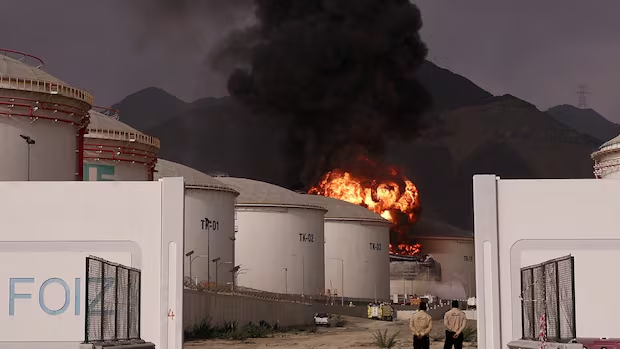
Headline: U.A.E.’s Security Erodes Amid U.S.-Iran Tensions
The ongoing tensions between the United States and Iran have significantly undermined the United Arab Emirates’ (U.A.E.) sense of security, as heightened military postures and regional instability create an unpredictable environment. This development is particularly pronounced following recent confrontations, including military skirmishes and retaliatory actions, escalating since late 2022 in the Gulf region. The U.A.E., a key ally of the U.S. in the Middle East, now faces the daunting challenge of reassessing its security frameworks in the wake of a perceived increase in Iranian aggression.
As America’s military presence in the Gulf escalates, the geopolitical landscape has shifted dramatically, leaving the U.A.E. grappling with fears of becoming a direct target in the widening U.S.-Iran conflict. The Emirates had relied on the United States for security, but the prospect of being caught in the crossfire has become alarmingly real. Analysts argue that this scenario is reshaping the U.A.E.’s foreign policy and security strategies, pushing the nation to bolster its own military capabilities.
Historically, the U.A.E. has positioned itself as a stabilizing force in the region, playing a significant role in the Arab coalition against Iran-backed groups in Yemen and elsewhere. However, the perception of a shrinking U.S. umbrella has incited concerns over whether the U.A.E. can continue to fulfill its strategic objectives without significant American support. This new uncertainty draws attention to the long-standing reliance of Gulf states on U.S. military power as a counterbalance to Iranian influence.

In a recent report from the International Institute for Strategic Studies, experts indicate that the U.A.E. may need to reconsider its security alliances and even explore new partnerships that can provide alternative strategies to counter Iranian operations. These shifts suggest a potential move toward strengthening defense ties with other regional allies, including Israel, particularly following their normalization of relations in 2020 through the Abraham Accords.
The escalating rhetoric from Iranian officials, combined with the U.S.’s hardline stance, creates a complex atmosphere for the U.A.E. government, which must delicately navigate these tensions as it seeks to maintain both internal and external stability. There are fears that the Iranian regime may increasingly employ asymmetric warfare tactics, including cyber attacks and drone strikes, thereby directly threatening the U.A.E.’s critical infrastructure.
The U.A.E., which hosts a significant expatriate community and vibrant trade sector, is particularly vulnerable to the fallout from any military confrontation. Economic stability is crucial for maintaining the Emirates’ reputation as a regional hub for investment and tourism. The prospect of military actions could deter foreign investment and disrupt trade routes, leading to broader economic implications.
Moreover, there have been public calls within the U.A.E. for the government to take more assertive action in regional security. This has led to discussions about increasing defense spending and modernizing military capabilities, potentially including advanced missile defense systems and cyber warfare units. The U.A.E. has already begun to invest heavily in UAV technology, illustrated by its recent contracts with international defense firms.
Saudi Arabia, another Gulf ally, shares similar concerns regarding Iranian activities and has witnessed attacks that have disrupted its oil infrastructure. This shared anxiety has led to enhanced collaboration between the U.A.E. and Saudi Arabia, with both nations seeking to fortify their defense partnerships and intelligence-sharing mechanisms. However, there remains a level of trepidation about the effectiveness of such measures given the uncertainty surrounding U.S. foreign policy in the region.
The U.A.E.’s challenge is further complicated by its engagement in Yemen’s devastating civil war, where it faces Iran-backed Houthi rebels. The continuing conflict has resulted in significant humanitarian crises and has been a focal point of Iranian influence in the region. Calls for a resolution to the Yemeni conflict have grown louder, as stakeholders recognize that prolonged war only serves to empower Iranian proxies and instabilities.
In the realm of diplomacy, the U.A.E. is reportedly seeking to enhance communication channels with Iran to mitigate misunderstandings and potential escalations. This careful balancing act reflects a desire for regional de-escalation, aiming to establish a more stable security architecture that accommodates the interests of all Gulf nations while addressing the Iranian threat.
However, as the U.S.-Iran situation remains volatile, the U.A.E. finds itself in a precarious position. Experts recommend that the Emirates work closely with other Gulf Cooperation Council (GCC) members to develop a unified response to external threats, while also fostering dialogue with Iran to prevent conflicts. Unity among Arab states will be crucial in addressing the challenges posed by Iranian influence, particularly in light of former U.S. Secretary of State Henry Kissinger’s assertion that diverse Arab nations must create a coherent strategy to address mutual concerns.
As the U.A.E. navigates the new reality of diminished security assurances from the U.S., its leadership must confront a multifaceted dilemma: balancing its longstanding alliances with adapting to emerging threats. The decline of security assurances is prompting a reevaluation of strategies, partnerships, and military capabilities, marking a critical juncture in U.A.E. history as it strives to reclaim its sense of security amid instability.
In conclusion, the U.A.E.’s sense of security has undeniably been affected by the evolving dynamics of America’s ongoing conflict with Iran. The nation faces critical choices that could redefine its strategic positioning within the Gulf Cooperation Council and beyond, underlining the importance of a cohesive approach to regional security and diplomacy. As these tensions continue to evolve, the international community watches closely to see how the U.A.E. adapts to protect its interests while seeking stability in an increasingly unpredictable geopolitical landscape.