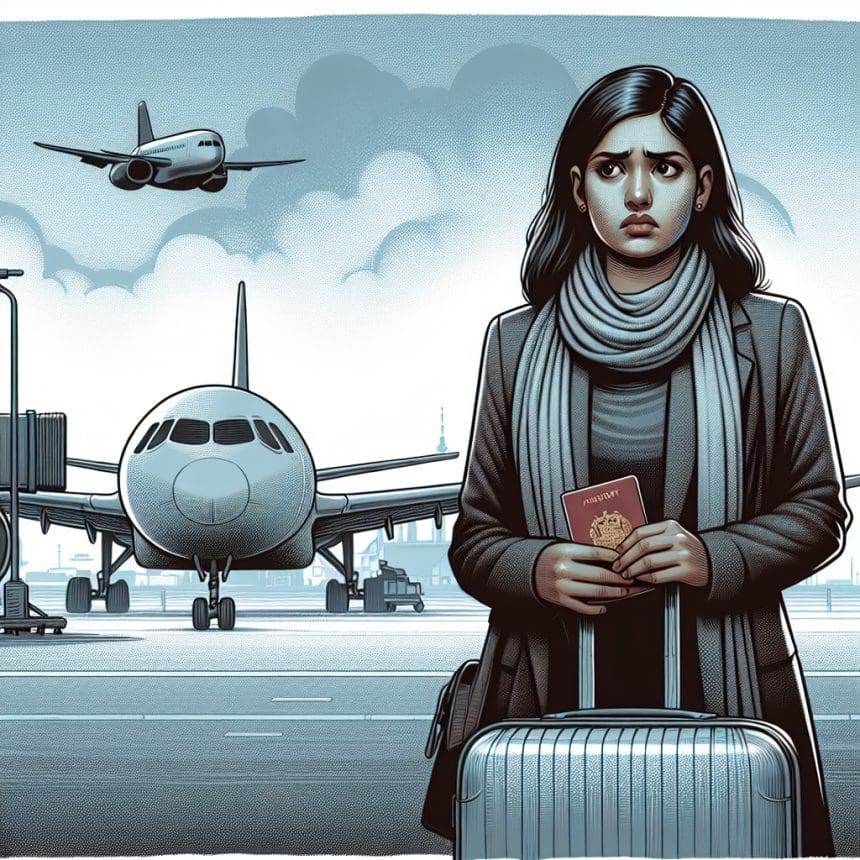
Headline: European MP Rima Hassan Denied Entry to Canada Amid Controversy
In a significant diplomatic episode, Rima Hassan, a pro-Palestine member of the European Parliament, announced that she was denied entry to Canada while attempting to attend an international conference on human rights in Ottawa. The incident occurred on February 15, 2024, and has raised questions regarding Canada’s stance on international political figures and the implications for freedom of movement. Hassan, a vocal advocate for Palestinian rights, claims her exclusion is part of a broader pattern of restricting dissenting voices in the global discourse surrounding Israel and Palestine.
Following her attempt to enter Canada, Hassan took to social media to express her outrage and bewilderment. "I have been denied entry to a country that prides itself on being a sanctuary for human rights defenders. This is an affront not only to me but to all who advocate for justice," she tweeted shortly after being turned away at the border. The Canadian authorities have yet to provide a clear explanation for the denial, raising questions about the criteria used to assess the entry of foreign political figures and activists.
Hassan is a prominent figure within the European Parliament, representing a coalition of parties that align with Palestinian interests. Known for her outspoken views on Israel’s policies in Gaza, she has garnered both support and criticism during her time in office. As a member of the parliament’s Foreign Affairs Committee, her presence at the human rights conference was expected to spark important discussions around international law and humanitarian support for the Palestinian people.

Canada has a long-standing policy of welcoming political figures from around the world, especially those advocating for human rights. However, this incident highlights a potential shift in that approach, particularly regarding individuals associated with contentious geopolitical issues. Political analysts have begun to debate whether Hassan’s exclusion signals a calculated decision by Canada to distance itself from pro-Palestinian sentiments at a time when pro-Israel advocacy groups are increasingly active in the country.
In a statement released after her denied entry, Hassan called on international human rights organizations to reevaluate their support and engagement with countries that suppress dissenting voices. "If we remain silent in the face of such acts of oppression, we are complicit. All voices must be heard, especially those of marginalized communities,” she stated, emphasizing her commitment to advocating for Palestinian rights despite the setback.
Adding complexity to the situation, Hassan’s exclusion has raised eyebrows among her supporters, many of whom believe that her denial of entry is part of a broader pattern of silencing progressive activists. Supporters took to social media, asserting that Hassan’s views on the Israeli-Palestinian conflict make her a target for countries that have strong ties to Israel. Critics argue that Canada’s decision could reflect internal political pressures that prioritize diplomatic relations over human rights advocacy.
The reaction to Hassan’s denial has not been limited to social media. Prominent human rights organizations have expressed solidarity with her cause. Human Rights Watch issued a statement expressing concern over the necessity for open dialogue on human rights issues, urging Canada to uphold its commitment to allowing free expression. "Denial of entry on the basis of views contrary to state policies stands against the very principles of democracy and human rights,” the organization stated.
Furthermore, this incident has coincided with a renewed debate within Canada regarding its foreign policy priorities in the Middle East. With the Canadian government’s commitment to peace and human rights becoming increasingly scrutinized, political commentators are questioning whether this incident reflects a trend toward conformity in political sentiments.
While Hassan’s situation appears to be an isolated incident for now, there may be repercussions for Canada’s relationships with other nations similarly judged by their positions on Israel and Palestine. Political strategist Jenna Clarke notes, "As international sentiment shifts, Canada’s willingness to engage openly with all perspectives could either broaden its influence or limit its ability to act as a mediator in future dialogues.”
The implications of this denial to enter cannot be understated. Rima Hassan’s exclusion could influence other pro-Palestine activists considering travel to Canada or other Western nations, potentially creating a chilling effect on international advocacy for Palestinian rights. Observers of this unfolding story note that the trend could further isolate voices advocating for Palestinian liberation, particularly in regions already marginalized in global discourse.
As the issue gains traction in both Canadian and European media, it has the potential to reshape discussions about immigration and entry policies for political figures. Lawmakers in Canada may face increased pressure to clarify their guidelines regarding entry for individuals who advocate politically sensitive causes.
In conclusion, Rima Hassan’s denied entry to Canada is not just a personal setback. It serves as a pivotal event that encapsulates the broader geopolitical tensions surrounding the Israeli-Palestinian conflict and raises important questions about the future of political discourse, human rights advocacy, and the extent of freedom of movement for those who speak out against injustice. As the world continues to watch, the developments surrounding Hassan’s case may serve as a harbinger for future diplomatic relations and international advocacy efforts.