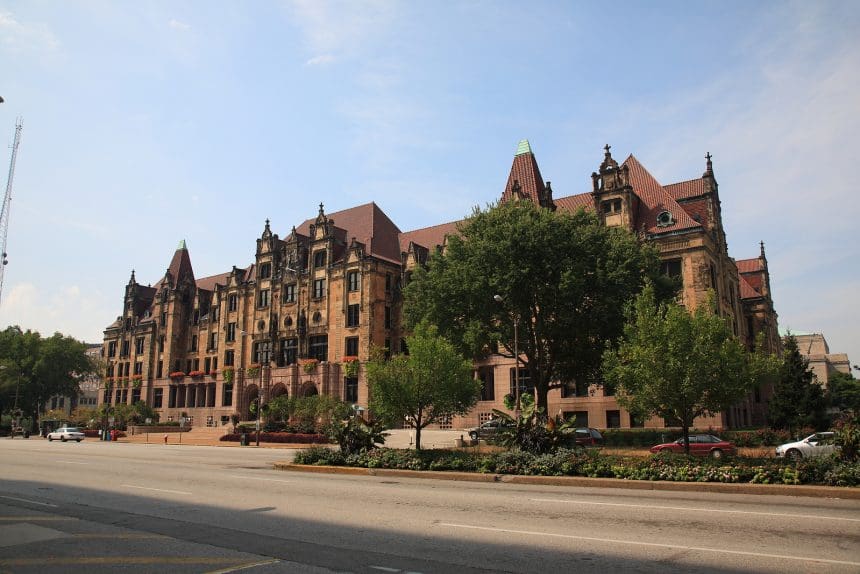

One Region, Two Paths: Why St. Louis Must Rethink Fragmented Governance
ST. LOUIS, MO (STL.News) For more than three decades, the contrast between Chesterfield and St. Louis, Missouri, has grown sharper with each passing year. One has steadily expanded its economic footprint, attracted investment, and reinforced public confidence. The other has struggled with population loss, uneven redevelopment, persistent vacancy, and the visible consequences of long-term decline. When these two paths are viewed side by side, the conclusion is difficult to avoid: the St. Louis region is not failing because it lacks assets, talent, or opportunity. It is failing because it is governed as a collection of disconnected entities rather than a single, coordinated metropolitan system.
This is not merely a debate about city versus suburb. It is a structural argument about how power, resources, and accountability are distributed across the region—and whether that structure still makes sense in the modern economy.
Thirty Years of Diverging Outcomes in the St. Louis Region
Over the past 30 years, Chesterfield has followed a model that emphasizes predictability, coordination, and a clear development philosophy. It invested heavily in infrastructure, positioned itself as a destination for employers, and maintained a consistent approach to public safety and business regulation. The result has been visible growth: office parks, retail corridors, employment centers, and rising household prosperity.
During the same period, the City of St. Louis experienced the opposite trajectory. Population declined significantly, neighborhoods hollowed out, and large sections of the city struggled to attract sustained private investment. While individual redevelopment projects succeeded, they rarely produced the compounding momentum seen in fast-growing suburban centers. Instead, progress arrived in isolated pockets, often offset by deterioration elsewhere.

This contrast is not about geography or demographics alone. It is about governance capacity and structural coherence.
St. Louis, MO – Fragmentation as the Region’s Core Weakness
The St. Louis metropolitan area is governed not as a unified region, but as a patchwork of municipalities—each with its own mayor, council, police department, courts, procurement systems, and development incentives. St. Ann, like many small municipalities, operates independently despite being economically inseparable from the surrounding region. The result is a system that duplicates costs while diluting strategic power.
From a taxpayer’s perspective, this fragmentation is expensive. Residents fund multiple layers of government that often perform identical functions within a few miles of each other. From a business perspective, it is confusing and discouraging. Investors face inconsistent rules, overlapping jurisdictions, and shifting political priorities depending on which municipal boundary they cross.
In contrast, Chesterfield’s growth has benefited from clarity. Its development strategy is easier to understand, navigate, and market. That clarity translates directly into confidence—and confidence attracts capital.
The County Is the Strength, Not the Weakness
The real engine of the region is St. Louis County. It contains the majority of the region’s population, workforce, and economic activity. Yet instead of operating as a unified metropolitan government, the county is constrained by internal competition among dozens of municipalities.
When small cities compete for sales tax revenue, development incentives, and retail projects, the region as a whole loses. Projects are shuffled from one municipality to another rather than added net-new to the metro. Tax incentives cancel each other out. Infrastructure planning becomes reactive instead of strategic.
This internal competition explains why growth in places like Chesterfield can coincide with stagnation or decline in the city core. The region is not losing opportunity—it is redistributing it inefficiently.
The Cost of Maintaining 90 Separate Governments
Operating nearly 90 municipal governments within one county creates systemic inefficiencies that compound over time:
- Duplicated administration: Multiple city halls, finance departments, legal teams, and IT systems performing the same tasks.
- Fragmented public safety: Separate police forces with varying standards, training, and coordination.
- Inconsistent development policy: Each municipality is pursuing its own incentives without regard for regional impact.
- Unequal service delivery: Residents receive different levels of service depending on municipal borders, not tax contribution.
These costs are rarely visible on a single line item. Still, collectively they represent millions of dollars annually—funds that could otherwise support infrastructure, public safety, housing stabilization, and economic development.
Why the City of St. Louis Cannot Recover Alone
The City of St. Louis faces challenges that exceed the capacity of municipal self-correction. Decades of population loss have reduced its tax base while leaving it responsible for infrastructure built for far more residents. Vacant buildings, underutilized land, and aging systems create ongoing fiscal pressure. Recent disasters, including tornado damage in 2025, further stretched administrative and financial capacity.
Expecting the city to resolve these challenges independently ignores the reality that the region functions as a single labor market and economic ecosystem. When the city struggles, the region’s national image suffers. When tourism weakens, the entire state feels the impact. When investors perceive instability, they look elsewhere—not just outside the city, but outside Missouri.
City of St. Louis – The Case for a Single Metropolitan Government
A merged metropolitan structure would not erase local identity. Neighborhoods would remain neighborhoods. Community traditions would endure. What would change is the administrative framework that governs the region’s shared assets and responsibilities.
Under a unified system:
- Public safety planning could be coordinated region-wide.
- Impact, not municipal borders, should prioritize infrastructure investment.
- Development incentives could be aligned to grow the regional economy rather than shift it internally.
- Administrative duplication could be reduced, freeing resources for frontline services.
Most importantly, accountability would become clearer. One regional government means one strategic plan, one budget framework, and one set of performance benchmarks.
Learning From Chesterfield’s Model—Without Copying It Blindly
Chesterfield’s success offers lessons, not a template. Its growth model works in part because it operates within a coherent governance structure. The city’s leadership can act decisively because authority is not fragmented across dozens of competing jurisdictions.
A unified St. Louis region would gain similar advantages at scale. Instead of municipalities competing for marginal wins, the region could pursue transformational projects: large-scale redevelopment, coordinated transit improvements, housing stabilization programs, and tourism investments that reinforce the “Gateway to the West” identity.
Addressing the Fears That Block Reform
Opposition to consolidation often centers on fear—fear of losing local control, fear of tax increases, fear of cultural erasure. These concerns are legitimate but not insurmountable.
A credible merger framework would include:
- Guaranteed neighborhood representation.
- Transparent tax and spending rules.
- Service-level standards are enforced region-wide.
- Explicit protections against disproportionate burden on any single community.
The goal is not to centralize power for its own sake, but to align governance with economic reality.
Who Is Winning, and Why It Matters
The comparison between Chesterfield’s growth and St. Louis’s decline is not a morality play. It is a governance case study. Chesterfield has benefited from coherence, predictability, and unified decision-making. Fragmentation, legacy structures, and limited regional authority have constrained the City of St. Louis.
As long as the region remains divided into dozens of municipalities competing within the same economy, growth will continue to favor areas with the least friction—often at the expense of the historic core.
A Regional Choice With Statewide Consequences
Missouri has a vested interest in the outcome. St. Louis is not just a city; it is a symbol, a tourism anchor, and a major economic engine. Allowing it to weaken through structural paralysis harms the entire state’s competitiveness.
A unified metropolitan government would send a clear signal: the region is prepared to govern itself as one economy, one workforce, and one future.
Conclusion: One Region, One Direction
The past 30 years have already delivered their verdict. Fragmentation produces uneven winners and predictable losers. Coordination produces momentum. The choice facing the St. Louis region is whether to continue managing decline through dozens of disconnected governments—or to embrace a structure capable of matching its scale, history, and potential.
The region does not need 90 strategies competing with each other. It needs one.
© 2025 STL.News/St. Louis Media, LLC. All Rights Reserved. Content may not be republished or redistributed without express written approval. Portions or all of our content may have been created with the assistance of AI technologies, like Gemini or ChatGPT, and are reviewed by our human editorial team. For the latest news, head to STL.News.