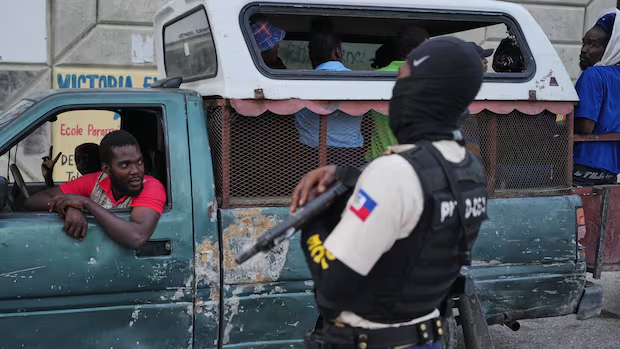
Headline: Haiti’s Farming Regions Struggle Amid Ongoing Gang Violence
In the wake of a brutal massacre over the weekend, armed gangs in Haiti’s farming regions continue their violent campaigns, posing a significant threat to local communities. The violence erupted on Saturday in the Artibonite Valley, known as the country’s agricultural heartland, leading to multiple fatalities and forcing residents to flee their homes. The concerted efforts by gangs to consolidate power in rural areas, compounded by the government’s inadequate response, have left farming communities in despair as they grapple with the escalating crisis.
As reports emerge detailing the grim aftermath of the massacre, local leaders express frustration and fear that the government’s inaction is exacerbating the situation. Eyewitness accounts recounted scenes of chaos, with gang members reportedly attacking homes and farms, leaving locals in a state of terror. The massacre claimed the lives of at least a dozen individuals and injured many more, further destabilizing an already precarious region.
The recent violence can be traced back to a power struggle among various gangs vying for control over agricultural resources and trafficking routes. In recent months, there has been a marked increase in clashes, as criminal groups expand their influence into the countryside, moving away from urban centers where law enforcement efforts have been slightly stronger. The situation has worsened as a combination of economic despair and political instability continues to fuel the conflict.

Local farmers, who already struggle with poverty and inadequate resources, are now facing violence that threatens to cut off their access to markets and essential supplies. “We fear for our lives, and now we have to worry about food security as well,” said one farmer, speaking on the condition of anonymity. With planting season approaching, the disruptions caused by gang violence threaten not only local food production but also the livelihoods of families dependent on agriculture.
International reaction to the crisis has been limited, exacerbating the feeling of abandonment among the Haitian populace. The United Nations and several humanitarian organizations have called for increased aid and intervention, but concrete actions remain elusive. Many Haitians feel that without decisive international support, the cycle of violence will continue unabated. “We need help now. Our lives and our future are at stake,” a community leader stressed during a recent gathering of local farmers.
The situation in Haiti highlights the complexities of gang governance in a country where the rule of law has all but collapsed. With the absence of effective governmental authority, gangs have stepped in to fill the void, establishing their own forms of law and order while perpetuating violence and fear. “In many areas, people are afraid to speak out or seek help from the police, as they fear retribution from gangs,” noted a local human rights advocate.
Haiti’s political landscape further complicates efforts to restore stability. The assassination of President Jovenel Moïse in July 2021 plunged the nation into deeper chaos, with no clear successor able to unify the fragmented political factions. As a result, governance has dwindled, and gang violence flourishes. Calls for a national dialogue have been met with skepticism, as various groups continue to vie for power amid an increasingly desperate population.
As the crisis unfolds, there are growing concerns about humanitarian conditions in the affected regions. Food shortages, displacement, and lack of medical care are becoming increasingly common. The Haitian Red Cross reports that thousands of families have been displaced in recent weeks, fleeing from violence into makeshift camps where conditions are dire. Access to clean water and sanitation has significantly deteriorated, increasing the risk of disease outbreaks.
Over the weekend, community leaders organized a peaceful march in Petit-Goâve, calling for government intervention and international assistance. “We cannot allow our future to be dictated by violence,” urged a spokesperson at the event. “We want our farms back; we want our lives back.” The march aimed not only to raise awareness but also to show solidarity among those who have been affected by the violence.
Despite the grim reality, there are glimpses of resilience and hope among the farming communities in Haiti. Grassroots organizations are mobilizing to provide support, offering food and resources to those in need. In some pockets, farmers have banded together to create local cooperatives aimed at securing their livelihoods despite the threats posed by gangs.
Online campaigns and social media outreach have also gained traction, as Haitians abroad raise funds for initiatives aimed at providing emergency supplies and medical assistance. The resolve among ordinary citizens continues to shine as they strive to reclaim their communities and demand accountability from those in power.
As Haiti’s farming regions grapple with gang-led violence, the world watches closely, aware that the repercussions of inaction could resonate far beyond the borders of this beleaguered nation. The international community must acknowledge the gravity of the situation and respond with urgency, crafting a strategy that not only addresses the immediate humanitarian needs but also seeks to establish long-term solutions for peace and stability.
In conclusion, the ongoing violence in Haiti serves as a stark reminder of the challenges faced by nations struggling with governance, poverty, and crime. As armed gangs exert their influence, the plight of ordinary citizens continues to escalate. The time for action is now, and the global community must rally to support Haiti in overcoming one of its darkest hours. Without swift intervention, the cycle of violence may solidify, leading to further devastation for the country that many still hope to restore.