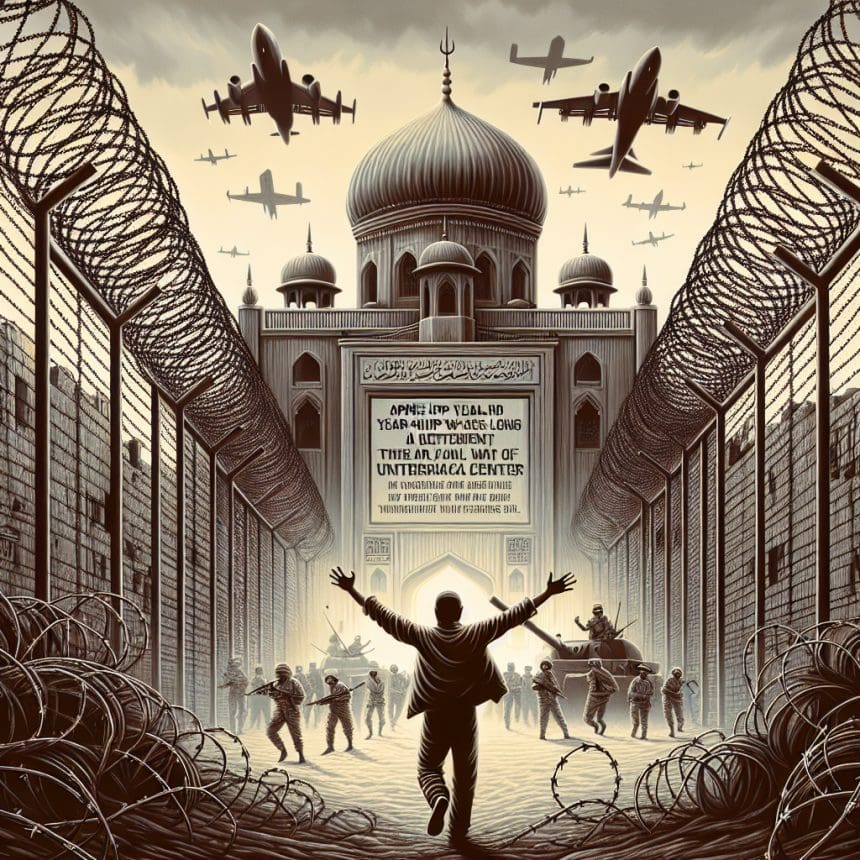
Headline: Final Detainee from 2025 Gaza War Protest Released
In a significant development, the last remaining detainee from the 2025 crackdown on protests against the Gaza war was released on Tuesday, marking one year since widespread demonstrations in the United States aimed at the conflict in the Middle East. The protest, sparked by escalating violence and humanitarian concerns, saw thousands take to the streets across various cities, drawing sharp responses from law enforcement. The individual’s release has reignited discussions about civil rights, government response to dissent, and the legacy of the protests.
The protests that began in early 2025 stemmed from a growing public outcry against the U.S. government’s support for Israeli military actions in Gaza, which had resulted in significant civilian casualties and displacement. Activists, students, and concerned citizens converged on major metropolitan centers like New York, Los Angeles, and Chicago, demanding an end to military aid and a re-examination of U.S. foreign policies in the region. The demonstrations began peacefully but escalated, leading to clashes with police and, ultimately, the arrest of numerous participants.
In the midst of the crackdowns, which many labeled excessive, authorities justified their actions by citing public safety concerns. Videos circulated on social media showing officers using force against protesters, further polarizing public opinion. Critics argued that the government’s approach violated constitutional rights and stifled free speech. The last detainee’s release, after extensive legal battles, comes as a relief to advocates who have fought for the release and vindication of arrested protesters.

Human rights organizations such as the ACLU and Amnesty International had closely monitored the situation, calling for investigations into the treatment of detainees and the legality of the arrests. They argued that many of those detained were simply exercising their right to assembly, a fundamental democratic principle. In the years following the protests, public sentiment remains deeply divided; some see the demonstrations as necessary with a focus on social justice, while others claim they disrupted public order.
As the news of the detainee’s release spread, it was met with a mix of joy and reflection among activist circles. “Today marks an important step for justice and a reminder of the power of grassroots movements,” said Emma Rodriguez, a spokesperson for the Coalition for Peace and Justice. “While we celebrate this release, we are also reminded of the many who suffered unjustly during the protests and the continued struggle for accountability.”
While significant changes in policy remain elusive, lawmakers have begun to engage in dialogue about addressing the underlying issues raised during the protests. Some politicians have initiated legislative proposals aimed at reassessing military aid to Israel, promoting diplomatic solutions, and safeguarding citizens’ rights to protest. This dialogue comes after the 2025 protests catalyzed heightened public awareness of international humanitarian crises and their impact on American foreign policy.
Looking ahead, many activists are advocating for systemic changes that transcend mere policy adjustments. They emphasize the importance of ongoing public engagement, education, and mobilization to encourage responsible governance and accountability from elected officials. “The release of the last detainee is just one piece of a larger puzzle,” noted activist Sarah Kim. “We must continue to fight for a world where every individual can protest without fear of retribution.”
As the political landscape continues to evolve, the impact of the Gaza war protests of 2025 will likely resonate for years to come. Scholars and political analysts are already examining how these events will influence future movements and activism in America. The discussion surrounding the balance between public order and civil liberties remains urgent, emphasizing the need for open dialogues and constructive engagement.
In communities across the U.S., grassroots organizations are mobilizing to ensure that the lessons learned from these protests are not forgotten. Educational events, community forums, and workshops are being organized to discuss the intersection of human rights, foreign policy, and civic engagement. “We cannot afford to let this moment pass us by,” urged community leader Marcus Trent. “Our fight for justice and peace is a continuous journey, and we have a responsibility to hold our leaders accountable.”
The release of the last detainee serves as both a conclusion and a beginning. For many, it symbolizes hope for systemic change and a commitment to advocating for human rights—both domestically and abroad. The gatherings that sparked such nationwide protests may have subsided, but the movement’s spirit and mission remain alive.
In the coming months, more conversations about the policies that led to the protests are likely to surface as new legislation and initiatives take shape. The 2025 Gaza war protests have left an indelible mark on American society, and as we move forward, both supporters and detractors of the protests will continue to grapple with the complexities of activism in a polarized political environment.
The recent focus on civil liberties has potential ramifications for future protests and government responses. As activists plan for future actions, their experiences from the past year will likely inform their strategies, ensuring their voices remain heard in the ongoing dialogues surrounding national and global issues.
The story doesn’t end with the release of the last detainee; it is just the beginning of renewed efforts to advocate for change, accountability, and the safeguarding of fundamental rights. The road ahead may be long, but the ongoing commitment to peace, justice, and activism remains a powerful force in shaping the future.