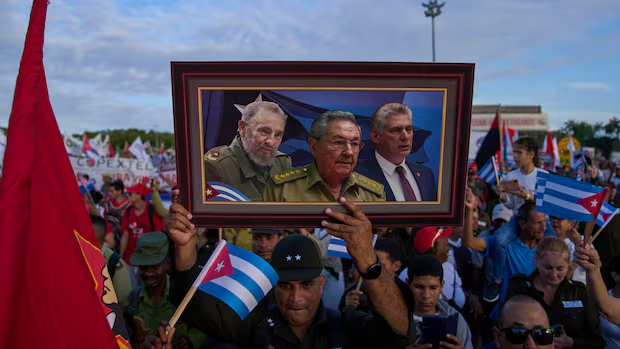
Headline: Raul Castro Engages in U.S. Talks, Says Cuba’s President
In a significant diplomatic development, Raul Castro, the former leader of Cuba, is participating in discussions regarding U.S.-Cuba relations, as confirmed by Cuba’s current President, Miguel Díaz-Canel. This announcement was made during a press conference held in Havana on Wednesday, reflecting ongoing efforts to mend ties between the two nations that have historically been fraught with tension. The talks aim to address a range of bilateral issues, including trade, immigration, and human rights, marking a noteworthy moment in the evolving landscape of Cuba-U.S. relations.
As historical context reveals, the relationship between the U.S. and Cuba has experienced dramatic fluctuations over the decades, from serious conflicts during the Cold War to a brief thaw under the Obama administration. As the diplomatic veil lifts again, the involvement of Castro—recognized as a pivotal figure in Cuba’s political landscape—signals a desire for constructive dialogue and possibly a shift toward more open relations.
Contextualizing the Discussions
Cuba’s relationship with the United States has oscillated since President John F. Kennedy imposed an economic embargo in 1960, aiming to isolate Cuba following the Cuban Revolution that brought Fidel Castro to power. The subsequent decades saw numerous attempts to stabilize or destabilize the relationship, but the election of Barack Obama in 2008 marked a turning point with attempts to normalize relations. However, under President Donald Trump, many of these initiatives were reversed, leaving Cuba facing economic hardships exacerbated by the COVID-19 pandemic and continued restrictions.

Given this backdrop, the current discussions involving Raul Castro and the U.S. open a potential pathway toward renewed negotiations. President Díaz-Canel emphasized that the meetings would explore critical concerns that have long contributed to tension and misunderstanding between the two nations.
Key Areas of Focus
The bilateral talks are expected to focus on several key areas:
-
Trade Relations: The economic embargo has caused significant strain on Cuba’s economy, leading to shortages of essential goods. Restructuring trade pathways could be a priority for both nations.
-
Immigration Policies: Historically, immigration has been a contentious issue, with numerous Cubans fleeing to the U.S. in search of better opportunities. Adjustments to immigration policies may be explored to offer a structured approach to migration.
-
Human Rights: The U.S. has consistently criticized Cuba on human rights issues, particularly in terms of political freedoms and civil liberties. President Díaz-Canel’s administration may be prepared to discuss reforms but is likely to stress sovereignty and internal affairs.
- Public Health: Additionally, the COVID-19 pandemic highlighted the importance of international collaboration in public health. Both countries may benefit from sharing medical knowledge and resources.
Responses from Stakeholders
The announcement has generated a variety of responses from stakeholders, including U.S. lawmakers, human rights advocates, and ordinary Cuban citizens. Some welcome the discussions as an opportunity to stabilize relations, while others express skepticism regarding the Cuban government’s willingness to implement meaningful reforms. Voices from the Cuban opposition stress that without tangible improvements in human rights, any diplomatic gestures may be dismissed as mere façade.
In the United States, reactions have been mixed, with some advocating for engagement as a means to encourage change within Cuba, while others remain firm in their critiques of the regime’s policies and treatment of dissenters. Congressional members have begun to mobilize, emphasizing the need for oversight in any agreements that may emerge from the negotiations.
Significance of Raul Castro’s Involvement
Raul Castro’s participation is particularly noteworthy due to his historical role in shaping modern Cuba. After taking power from his brother Fidel in 2008, he focused on economic reforms while maintaining the Communist Party’s grip on political power. His return to negotiations showcases a willingness to engage in dialogue despite previous assertions that he would step back from public life.
Furthermore, Castro’s involvement may also signal internal support from Cuba’s leadership for renewed discussions. Analysts suggest that this partnership between Castro and Díaz-Canel could be crucial in facilitating a balanced approach toward U.S. relations while allowing for domestic discussions on reform.
Future Implications
As the details of these negotiations unfold, the future implications for both U.S. and Cuban citizens are significant. Should fruitful agreements emerge, we could witness changes not just in policies, but also in public perceptions and the broader geopolitical landscape of the Americas.
Furthermore, any successful dialogue may also inspire other nations facing similar diplomatic challenges, showing that sustained discussions can lead to meaningful resolutions, even in a historically contentious relationship.
Conclusion
Raul Castro’s participation in talks with the U.S., as announced by President Díaz-Canel, represents a pivotal moment in the complicated history of U.S.-Cuba relations. The outcome of these discussions could redefine economic ties, reshape immigration frameworks, and potentially spur reform within Cuba itself. As stakeholders on both sides closely monitor developments, the international community holds its breath for what could be a transformative chapter in Cuban history. Dialogue remains an essential tool for navigating the complexities of international relations, and the current talks may serve as a beacon of hope amid a stormy geopolitical landscape.
In the coming weeks and months, updates on this diplomatic initiative will be keenly awaited, providing further insight into the potential reconciliation between two neighboring nations with a tumultuous history.