


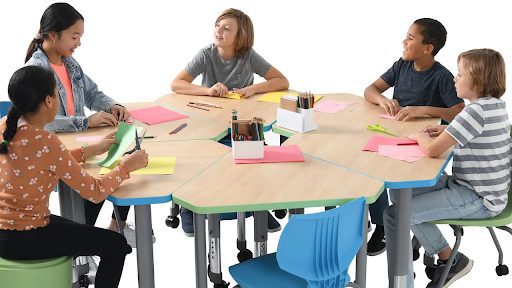
ST. LOUIS, MO – September 24, 2026 (STL.News) Classroom pods work best when desk shapes support movement, teamwork, and clear student sightlines. Traditional rectangular desks often struggle to form tight, functional groups without extra wasted space. Shape choice directly affects how easily students can rotate between individual and group work. Teachers designing flexible classrooms need desks that reconfigure quickly for many different daily formats. Group pods rely on shapes that fit tightly together without leaving awkward gaps behind. This guide compares common desk shapes to help schools plan smarter group seating arrangements.
Trapezoid Desks for Flexible Pod Layouts
Trapezoid desks angle outward, allowing several units to form a tight, neat circular cluster. That circular shape keeps every single student facing inward toward the shared group discussion. Worthington Direct School Furniture designs trapezoid tops with cleaner angles than most competing brands. Those cleaner angles let desks nest together tightly when pods suddenly need to expand. Teachers can rearrange trapezoid clusters within minutes between lecture time and daily group work. Trapezoid clusters usually come first when people explore different desk shape options for collaborative desks.
Hex Shaped Desks and Group Collaboration
Hexagon desks naturally form pods without needing extra desks to close any awkward gaps. Six equal sides let students face several neighbors at once during daily group tasks. Hex shaped desks also fit corners and irregular room layouts more easily than rectangles. Two hex desks pushed together create a diamond shape useful for smaller working pairs. Larger hex clusters generally support group sizes between four and six students quite comfortably. Rounded points on hex desks also reduce sharp corners near busy walkways and aisles.
Rectangular Desks in Traditional Classroom Pods
Rectangular desks still remain common because they stack, store, and ship far more easily. Pushing four rectangles together forms a basic square pod for smaller young student groups. This layout works well for schools with tight furniture budgets and limited floor space. Rectangular pods can feel cramped once more than four students suddenly try joining in. Corner gaps between rectangles often waste floor space that other shapes fill far better. Rectangle desks paired with other shapes keep classroom costs lower and layouts more flexible.
Mixing Shapes to Maximize Floor Space
Combining trapezoid and hex desks often uses classroom floor space much more efficiently overall. Mixed pods let teachers create both large daily clusters and smaller flexible breakout groups. Odd shaped corners between desk types can hold shared classroom supplies or technology carts. Teachers gain more seating options when several shapes work together in one shared room. Mixing shapes also helps schools avoid buying entirely new extra furniture every few years. Schools mix desk shapes deliberately, so classrooms adjust easily as enrollment rises or falls each year.
Choosing Shapes Based on Group Size
Small groups of two or three students often work best with simple hex pairs. Groups of four fit naturally into either small hex clusters or compact rectangle pods. Larger groups of five or six benefit most from flexible trapezoid or hex clusters. Very large pods of seven or more usually need combined custom trapezoid seating arrangements. Teachers choose desk shapes that match group size, so students stay close enough to collaborate easily. Getting the size and shape right prevents wasted space and extra awkward seating gaps.
Picking the right desk shape really comes down to how groups actually work together. No single shape works for every classroom or teaching style. Trying a few shapes in one classroom often reveals what students actually respond to. Small adjustments in shape and layout can noticeably improve focus and overall group energy. Teachers who experiment early on tend to always land on the right mix faster. The best pod comes from shapes that match how students actually learn.
View our Categories News page at STL.News



