Headline: Airstrikes in Beirut Reportedly Kill Six Amid Rising Tensions
Israeli airstrikes in central Beirut killed six people on Wednesday, according to Lebanese authorities. The strikes targeted areas linked to Hezbollah amid escalating tensions following recent confrontations in the region. The attack marks a significant escalation in military actions between Israel and Hezbollah, raising concerns over potential wider conflict.
In the early hours of Wednesday morning, an Israeli airstrike hit central Beirut, resulting in the deaths of six individuals, as reported by Lebanese officials. The strikes, which are said to have been aimed at Hezbollah-affiliated locations, come after a series of escalating military and political tensions in the region. The aftermath of this aggressive action not only underscores the fragile peace within Lebanon but also highlights a potentially dangerous spiral of retaliation.
Background of the Conflicts
The relationship between Israel and Hezbollah has long been fraught, characterized by a series of violent confrontations, political maneuvers, and sometimes uneasy truces. The Lebanese militant group, heavily armed and supported by Iran, has been in direct opposition to Israeli interests since its inception in the 1980s. Israel and Hezbollah have engaged in numerous skirmishes and conflicts over the decades, notably the 2006 Lebanon War, which resulted in significant casualties on both sides.

Recently, tensions have heightened due to several incidents along the Lebanon-Israel border, with shelling and rocket fire reported in both countries. The latest airstrike is widely perceived as a retaliation against Hezbollah for its role in recent border clashes and accusations of orchestrating attacks against Israeli forces.
Immediate Aftermath and Reactions
Following the airstrikes, Lebanese officials condemned the attack as an "act of aggression," emphasizing the need for international intervention. Prime Minister Najib Mikati called for an emergency meeting of the security cabinet to discuss the implications of the strike and whether additional defensive measures are required. "This attack is a blatant violation of our sovereignty and dignity," Mikati stated, urging the international community to take a stand against such military actions.
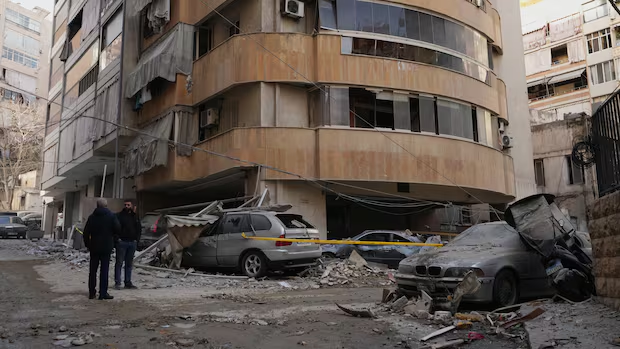
Local residents reported widespread panic in central Beirut, with emergency responders rushing to the scene to assist those injured in the airstrikes. Eyewitness accounts describe a chaotic environment, with smoke billowing from targeted buildings and sirens wailing through the streets. "It was very frightening; I’ve never experienced anything like this," said one local resident, who wished to remain anonymous. The psychological impact on civilians, who are already grappling with the complexities of daily life in a politically unstable region, cannot be understated.
Political Implications
This latest incident is likely to further complicate the delicate political landscape in Lebanon. The government faces mounting pressure to take a firmer stance against Israeli aggression while balancing the interests of various factions within the country. Hezbollah’s response to the airstrikes may also influence subsequent events, as the militant group has previously vowed to retaliate against Israeli military actions.
The broader regional implications of this event cannot be overlooked either. As tensions between Israel and Iran-aligned groups in the Middle East continue to escalate, the possibility of a wider conflict looms larger than ever. Analysts suggest that continued Israeli military operations may prompt Hezbollah to engage more actively in hostilities, thus potentially dragging Lebanon further into an armed confrontation.
The Human Cost
Beyond the political and military ramifications, the human cost is palpable. The six casualties, just the latest victims in a long history of conflict, serve as stark reminders of the precariousness of life in Lebanon. Families are shattered, and communities left to mourn are likely to bear a heavy psychological toll for years to come.
Human rights organizations have repeatedly called for accountability and clarity regarding the impact of military actions on civilian populations. The airstrikes not only resulted in loss of life but could also trigger new waves of displacement in a country that is still recovering from the economic crisis and the devastating port explosion of 2020. Local NGOs have ramped up their calls for humanitarian aid, both in response to immediate needs and the long-term implications of ongoing conflict.
International Responses
The international community’s response to the airstrikes has been mixed, with some nations expressing condemnation while others remain silent. The United Nations Security Council is expected to address the situation in an upcoming session, though the history of similar incidents suggests that significant action may be elusive. Countries closely aligned with Israel, particularly in the West, may support its right to defend itself against perceived threats, while others, particularly from the Arab world, may advocate for a more conciliatory approach toward Lebanon and its people.
Conclusion
The Israeli airstrikes killing six people in central Beirut serve as a flashpoint in an already fraught and complex geopolitical landscape. With tensions escalating rapidly, the potential for a wider conflict looms large, and the human cost of this cycle of violence is only beginning to unfold. As both national and international stakeholders assess the situation, the hope for peace amid the chaos hangs by a thread.
The eyes of the world remain closely focused on Lebanon, as developments unfold in what continues to be a deeply volatile region. The ramifications of these airstrikes will likely reverberate far beyond Beirut, affecting not only the immediate area but the broader Middle East and beyond.