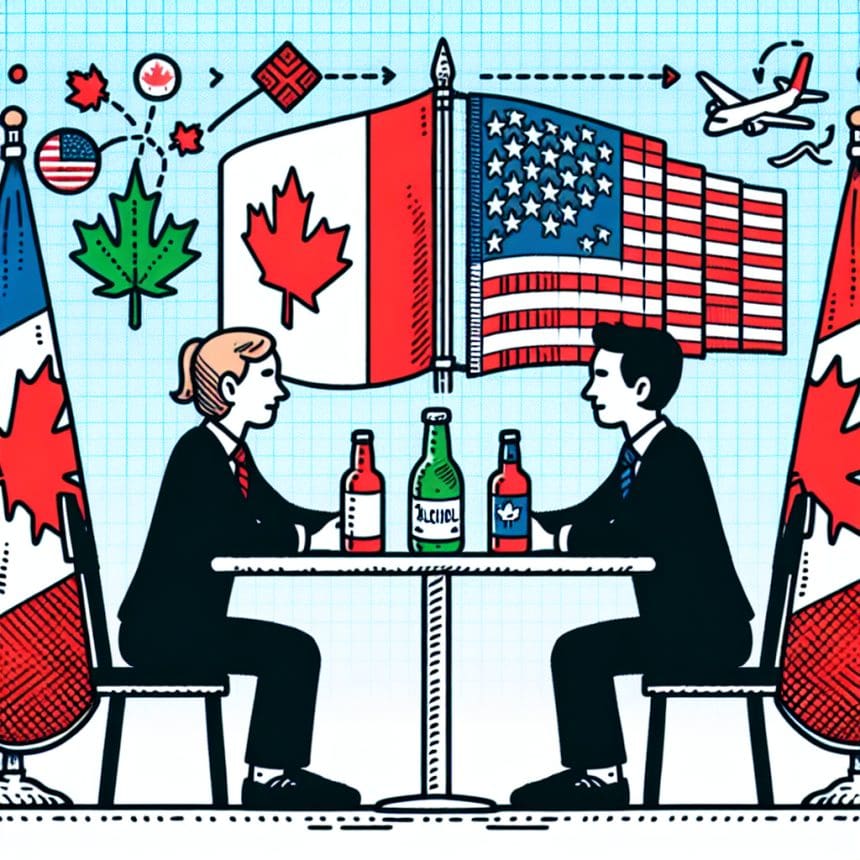
Headline: U.S. Flags Canadian Booze Bans as Trade Tensions Rise
Article:
American officials have raised concerns over recent restrictions on imported alcoholic beverages and Canada’s ‘Buy Canadian’ policy, labeling both as significant trade irritants. This development, highlighted in a report released earlier this week by the U.S. Trade Representative’s office, underscores escalating tensions between the neighboring countries as they attempt to navigate complex trade agreements amidst a challenging economic backdrop.
The U.S. government is primarily focused on two issues: restrictions that limit the sale of American alcoholic products in Canada and incentives that favor domestic alcohol producers. These actions are perceived as violations of the United States-Mexico-Canada Agreement (USMCA), which aims to promote fair trade practices and eliminate unjust barriers. Officials from the U.S. Trade Representative’s office argue that both policies could undermine the American economy and hurt consumers, thus prompting the need for a formal complaint to trade courts if the situation does not improve.

The Canadian government’s measures include limits on the volume of alcoholic beverages that consumers can bring across the border, which has been particularly disruptive for American companies looking to expand their market presence in Canada. This restriction is coupled with a ‘Buy Canadian’ initiative, which incentivizes Canadian consumers to purchase domestic products. Critics argue that such policies not only hinder fair competition but also violate existing trade agreements designed to foster cross-border trade.
This situation comes at a critical time as both countries are emerging from the economic fallout caused by the global pandemic. With inflation and supply chain issues still affecting the market, any barriers that exacerbate trade tensions could further strain economic recovery efforts. American companies claim that these restrictions have already resulted in significant losses in market share and threaten to stifle growth in one of their most lucrative foreign markets.
Trade relations between the U.S. and Canada have historically been robust, but recent years have seen increasing friction over various trade practices, including dairy quotas, softwood lumber tariffs, and now, alcohol sales. The Biden administration has made clear its intent to address grievances raised by American producers and ensure fair competition—emphasizing that cooperation between the two nations is essential for long-term stability and mutual economic benefit.
Experts believe that resolving these tensions is critical not only for the alcohol industry but also for broader trade relations. The U.S. exported approximately $1.6 billion in alcoholic beverages to Canada in 2022, making it the largest exporter of alcohol to its northern neighbor. Any sustainable trade agreements must address these emerging issues to create an equitable framework for both countries.
To mitigate the growing concerns, discussions have already begun between officials from both nations. However, some analysts argue that the rigidity of existing policies may pose challenges in reaching satisfactory concessions. Canadian trade representatives have reassured their American counterparts that they are committed to fair trade practices but insist that domestic policies are necessary to support local businesses in the face of global competition.
The ‘Buy Canadian’ policy, for example, aims to promote local industries that were hit hard during the pandemic. Critics of the policy argue that undue favoritism towards domestic products creates an uneven playing field and disregards the intricate interconnectedness of the North American economy. By prioritizing local goods, Canada risks alienating American producers while also potentially facing retaliatory trade measures.
Trade experts suggest that a resolution may involve a mutually beneficial compromise, where both Canadian and American companies can coexist and thrive in each other’s markets. The U.S. has previously approached similar issues through diplomatic channels, and there is hope that both sides can engage in meaningful negotiations to ensure the free flow of goods, including alcoholic beverages.
Stakeholders from various sectors—including agriculture, retail, and manufacturing—are already voicing their concerns over the potential ripple effects of these trade tensions. With upcoming negotiations on the trade policy agenda, both U.S. and Canadian officials are under pressure from their respective industries to arrive at a favorable outcome that promotes economic growth while upholding trade commitments.
A notable point of discussion during negotiations will likely center around the craft beverage market, which has seen explosive growth on both sides of the border. This sector not only provides significant employment opportunities but also contributes to local economies. American craft brewers, distillers, and vintners heavily rely on access to the Canadian market as they look to expand their brand presence internationally.
In light of the ongoing situation, it becomes crucial for consumers and businesses alike to remain informed about potential shifts in trade policies impacting alcohol sales. The outcome of these discussions could significantly change the landscape for both American and Canadian producers and consumers over the coming months.
Looking ahead, the integration of technology in trade practices may also emerge as a topic of interest during negotiations. Digital platforms and e-commerce are redefining how alcohol is marketed and sold. Ensuring that trade policies are adaptable to innovative business models will be essential for sustained growth across both economies.
As this story continues to unfold, it serves as a reminder of how interconnected global markets have become and highlights the need for ongoing dialogue and cooperation between neighboring countries. The American and Canadian markets stand at a crossroads, and the resolution of these trade irritants will have lasting implications for the decades-long partnership that has characterized U.S.-Canada relations.
In summary, while the rising tensions over alcohol sales and trade practices pose challenges, they also offer an opportunity for both countries to reaffirm their commitment to fair trade principles and explore avenues for collaboration that benefit both economies. Moving forward, a diplomatic approach appears essential for addressing the concerns raised and ensuring that mutual interests prevail.