Headline: Americans Stranded as Middle East Airspace Shuts Down
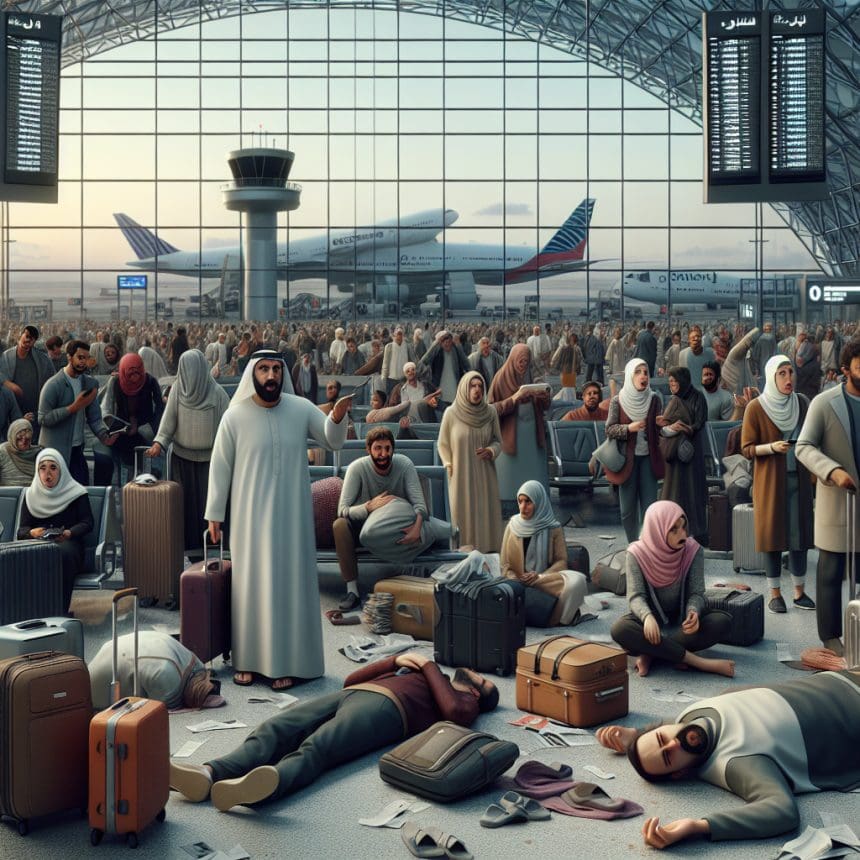
In a significant disruption to international travel, thousands of Americans found themselves stranded this week as several nations in the Middle East announced the closure of their airspace. This unprecedented measure, implemented amid heightened regional tensions and security concerns, has left travelers scrambling for alternative arrangements. Airlines are struggling to navigate the rapidly changing situation, with many flights to and from the region canceled overnight on Monday.
Reports indicate that at least 6,000 American citizens may be affected, spanning across various airports in the Middle East, including those in Israel, Lebanon, and Jordan. Passengers are feeling the brunt of the disruption, leading to frustration and uncertainty as they seek clarity on when they might be able to return home. The closures come on the heels of rising geopolitical tensions that have prompted governments to reassess flight safety.
Airlines such as Delta, American, and United have begun suspending their operations in these impacted areas, prioritizing the safety of their passengers and crews. As travelers await updates, many are turning to social media platforms to voice their frustrations, share their experiences, and connect with others in similar predicaments. Concerns about safety, lack of communication from airline representatives, and the challenge of finding alternative travel options have amplified stress levels among impacted travelers.

The sudden flight cancellations and airspace closures have left many Americans unsure of their next steps. For some, the trip was meant to be a vacation or business venture, while others were visiting family or friends. Regardless of the purpose, the common thread among these travelers is a profound sense of inconvenience and a longing for clarity.
Travel agencies and airlines are working tirelessly to accommodate affected travelers, but the rapidly evolving situation has resulted in limited options. Many airlines are directing customers to their websites or customer service lines, but long wait times are proving frustrating. Travel experts advise those stranded to remain patient and to stay updated through official airline communications and government advisories.
The U.S. State Department has issued a travel advisory for the region, urging Americans to reconsider non-essential travel due to the ongoing security situation. In light of these recommendations, many travelers are faced with the difficult choice of either rescheduling their trips or waiting it out in limbo. Those who had plans to explore popular tourist destinations now find themselves navigating uncertainty while trying to secure safe passage home.
In addition to individual travelers being affected, business operations have also faced setbacks as the disruptions extend to freight and commercial cargo flights. Companies relying on timely shipments are feeling the pinch as cargo planes are grounded, further complicating supply chain logistics in an already strained global environment.
The travel industry as a whole is bracing for the fallout from this disruption. Airlines and tour operators in the Middle East are facing cancellations that could lead to significant financial losses. With many countries dependent on tourism for economic stability, the long-term impacts of these closures may be felt well beyond the immediate crisis.
As the situation unfolds, airlines are working to establish new flight routes and communicate effectively with those affected. However, recovering from such a sudden disruption poses challenges not just for airlines but also for passengers seeking timely returns home. Many travelers remain hopeful for a swift reopening of airspace, allowing them to continue their journeys or return to the States without further delays.
For those planning to travel to the region in the near future, it is imperative to monitor the situation closely and stay informed about potential changes to air travel advisories. Experts recommend purchasing travel insurance that covers cancellations due to civil unrest or airspace closures to mitigate potential losses. As the world braces for possible further disruptions, the hope is that diplomatic efforts will yield results, stabilizing the region and allowing air travel to resume safely.
In closing, this developing story highlights the interconnectedness of global travel amidst geopolitical tensions. The plight of stranded Americans serves as a reminder of the unpredictability that travelers face in a world where safety concerns can suddenly impact even the most carefully planned itineraries. As airlines and governments work together to resolve the situation, the hope is for a swift return to normalcy for all those affected and a reassessment of travel safety protocols in regions marked by instability.
With many eyes on the skies over the Middle East, the future of air travel in and out of the region depends on effective crisis management and a commitment to maintaining safe passage for all travelers. Until then, those caught in the web of closures remain patient, hopeful, and eager for news that their journey will soon continue.