


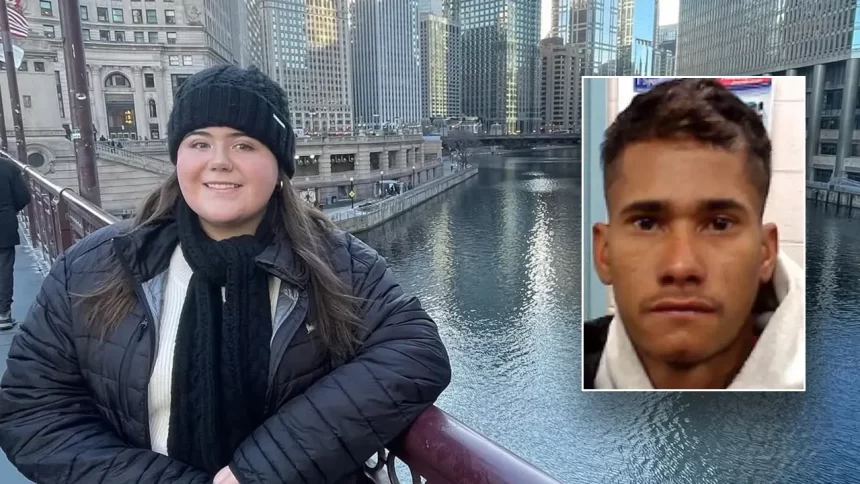
Headline: Venezuelan Arrested in Loyola Student’s Death Entered US Legally
A Venezuelan man has been charged in connection with the fatal shooting of a Loyola University student in Chicago, raising questions about immigration processes and public safety. The suspect, identified as 24-year-old Luis Aguirre, allegedly entered the United States legally under the Biden administration’s immigration policies. The incident occurred late Thursday evening near the university campus, generating significant media attention and sparking discussions about crime and the complexities of immigration status in the U.S.
According to police reports, Aguirre was arrested on Saturday after an extensive investigation into the death of 22-year-old student Maya Torres. Witnesses described a chaotic scene, with multiple shots fired shortly after 10 PM in the vicinity of the university. Torres, a senior majoring in biology, was pronounced dead at a local hospital shortly afterward. Investigators have indicated that the shooting may have been the result of a confrontation between Aguirre and Torres, though details remain unclear.
The incident has drawn a stark reaction from the Loyola community and local leaders, who express outrage over the tragic death of a promising student whose life was abruptly cut short. "Maya was an exceptional student who had a bright future ahead of her," said Dr. Jo Ann Rooney, the university’s president. "This senseless act of violence will not be forgotten, and we stand with her family during this difficult time."
Aguirre’s entry into the U.S. is raising eyebrows as he reportedly arrived on a temporary visa while applying for asylum, a process that has become a contentious topic in American politics. Under the Biden administration, numerous reforms have been made to streamline asylum applications, making it easier for individuals from crisis-stricken regions to find refuge in the United States. These measures, while aimed at humanitarian relief, are also being scrutinized as instances of violent crime connected to recent immigrants emerge.

However, experts in immigration law and public safety caution against politicizing Aguirre’s case. "It’s crucial to understand that crime can occur regardless of immigration status," says Dr. Amanda Reyes, an immigration policy analyst. "The vast majority of immigrants are law-abiding citizens, and this tragedy should not overshadow the contributions they make to our communities."
The details surrounding Aguirre’s visa status are still emerging, but his case offers insight into the complexities facing individuals seeking refuge in the U.S. Critics of current immigration policies argue that the system needs further reform to ensure that individuals who pose a threat are screened more rigorously. In the wake of Torres’s death, local officials are pressing for discussions on how to better integrate public safety measures with humanitarian efforts.
Furthermore, law enforcement officials are recognizing a rise in violent crime in urban areas, including Chicago. Statistics released by the Chicago Police Department show a concerning trend in shootings over the past months, leading to calls for both increased police presence and community involvement in crime prevention. "We must work together as a community to build safer neighborhoods," said Police Chief David Brown. "Engaging residents, local organizations, and schools is vital to addressing these issues at their roots."
In the aftermath of the shooting, the Loyola community has taken steps to ensure a supportive environment for students grappling with grief and fear. The university has organized counseling sessions and platforms for students to voice their concerns. "We want our students to feel safe and supported, especially during such a tragic time," said university spokesperson Lisa Henderson.
Aguirre faces several charges, including first-degree murder and possession of a firearm during a violent crime. He is scheduled to appear in court on Tuesday, where prosecutors are expected to present evidence collected during the investigation, including surveillance footage from the area where the incident occurred.
The Chicago mayor has also addressed the incident, condemning the violence and reiterating her commitment to public safety. "We cannot allow the actions of one individual to define our community or to instill fear among residents," Mayor Lori Lightfoot stated. "We will work tirelessly to ensure justice for Maya and to promote peace in our neighborhoods."
Supporters of Torres are organizing vigils and memorials to honor her memory. Friends describe her as passionate, kind-hearted, and exceptionally talented. "She had so many dreams and aspirations; it’s hard to believe she’s gone," said Claudia Ramirez, a close friend. "We need to celebrate her life and the impact she had on all of us."
This incident comes at a time when crime, especially in urban centers, has become a focal point of national debate. Advocates for community safety are urging policymakers to consider not only law enforcement strategies but also investment in education, mental health support, and community resources to address the underlying causes of crime. "We can’t just focus on enforcement. We need a holistic approach to safety," adds Dr. Reyes.
In conclusion, the fatal shooting of Maya Torres serves as a grim reminder of the complexities surrounding crime and immigration in the United States. The implications of Aguirre’s arrest will likely extend beyond the courtroom, influencing discussions on public safety and immigration reform. As the community grapples with the loss of a young life, the need for dialogue and proactive measures to prevent such tragedies in the future has never been more urgent.



