


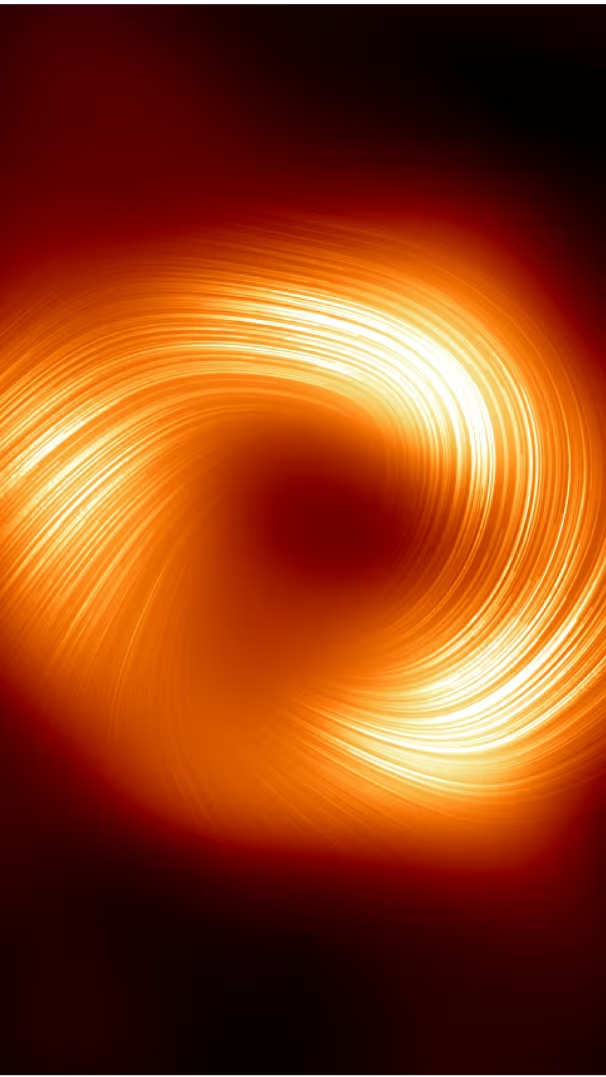
Capturing the Cosmic Void: Filming a Black Hole’s Dance
In a groundbreaking achievement, astrophysicists from the Event Horizon Telescope (EHT) collaboration have unveiled new methods for filming black holes in action, expanding our understanding of these mysterious cosmic phenomena. This development, which came to light during a recent press conference on October 30, 2023, in Washington, D.C., promises to advance our knowledge of black hole behavior and their effects on surrounding matter. By using innovative imaging techniques and data analysis, researchers are now able to capture real-time visuals of black holes, shedding light on their elusive nature.
Understanding Black Holes: A Cosmic Enigma
Black holes, regions in space with gravitational pulls so strong that nothing, not even light, can escape, have fascinated scientists for decades. Their existence was theorized over a century ago, but it has only been in recent years that technology has allowed researchers to observe them directly. The EHT, a global network of radio telescopes, successfully captured the first-ever image of a black hole in 2019, but filming these enigmatic objects in action posed different challenges.
The latest advancements revealed at the press conference focus on real-time imaging techniques that generate dynamic visual data, allowing scientists to observe the behavior of matter as it spirals into a black hole. This breakthrough follows years of preparation and collaboration among astrophysicists, data scientists, and engineers across multiple research institutions worldwide.
The Science Behind Filming Black Holes
One of the most innovative aspects of this new methodology is the application of very long baseline interferometry (VLBI). This technique combines signals from various radio telescopes located thousands of miles apart to create a synthetic aperture that simulates a telescope the size of Earth. This allows astronomers to achieve unprecedented resolution in their observations.
The research team also deployed advanced machine learning algorithms to process the copious amounts of data generated by these observations. By training models to recognize the complex patterns associated with black holes, scientists can filter out noise and artifacts, resulting in clearer and more accurate representations of these cosmic giants.
Why Filming Black Holes Is Important
Understanding black holes isn’t just an academic exercise; it has real implications for our comprehension of the universe. Black holes play a critical role in galaxy formation and evolution, influencing the dynamics of entire star systems. By observing how matter interacts with the gravitational pull of black holes, scientists can gain insights into fundamental questions about the nature of gravity, spacetime, and the fabric of the universe itself.
Additionally, filming a black hole in action can help validate existing theories in astrophysics, such as the general theory of relativity, which describes how massive objects warp spacetime. Discrepancies between observed behaviors and theoretical predictions could lead to groundbreaking revisions in our scientific understanding.
Challenges in Observing Black Holes
While the recent advancements represent a significant leap forward, filming black holes remains fraught with challenges. The immense distances involved mean that signals arriving at Earth can be weak and distorted. Researchers must meticulously calibrate their instruments to ensure data accuracy, requiring a high degree of precision in both hardware and software.
Moreover, black holes don’t exactly “move” in the traditional sense; instead, they pull surrounding matter into their gravitational field, resulting in plasma jets and accretion disks that can be more easily observed. Understanding and interpreting these phenomena require specialized knowledge and advanced computational techniques.
Real-World Applications of This Research
Beyond the theoretical implications, the technology and techniques developed for filming black holes have potential applications in other fields. For instance, the imaging methods used can be adapted for medical imaging, enhancing non-invasive diagnostics in healthcare. Furthermore, machine learning algorithms developed for astrophysics are increasingly being used in various sectors, including finance, logistics, and environmental science.
Future Implications for Space Exploration
As scientists continue to refine their methods, the prospect of capturing even more dynamic scenes around black holes could pave the way for new exploration missions. As technologies evolve, space agencies may be inspired to deploy advanced observational instruments in future missions, potentially leading to a deeper understanding of our universe.
Conclusion: A New Era of Cosmic Observation
The innovative techniques unveiled by the EHT collaboration mark the dawn of a new era in our ability to observe black holes. By merging advanced telescope technology with cutting-edge data analysis, researchers can finally begin to document the complex dance of matter swirling around these enigmatic cosmic entities. As our understanding of black holes evolves, so too will our broader comprehension of the universe, opening up numerous avenues for discovery.
This achievement serves as a reminder of the incredible potential still awaiting us in the farthest reaches of space. With each new method and breakthrough, we inch closer to unlocking the secrets of black holes, transforming our cosmic narrative and deepening our appreciation for the grandeur of the universe we inhabit.



