


Are you curious about the midterm election odds everyone is searching for right now? Unlike sportsbooks, prediction markets like Polymarket and Kalshi do not offer any betting. Traders buy and sell event contracts, and each contract’s price reflects the probability the market assigns to a result. Both platforms currently price a Democratic House, which would end unified Republican control of Congress and reshape the next two years.
Top Prediction Market Apps For US Midterm Elections
| Prediction Market App | Offer | Terms | Promo Code | |
| 1 | Polymarket | Deposit $10 and get a $20 trading bonus credit with code PRED100 | New users only. 18+. Sign up with code the code PRED100, complete identity verification, and deposit at least $10. The bonus is issued as trading credit, not withdrawable cash, and must be used under the promotion’s trading requirements. Not available in every state. Restrictions and eligibility requirements apply. | PRED100 |
| 2 | Kalshi | Trade $25 and get $25 in promotional trading credit with code PRED100 | New users only. 18+. Sign up with code PRED100, complete identity verification, and settle at least $25 in qualifying trades within the promotional window set out in the offer terms. Credit is issued as trading credit, not withdrawable cash, and expires if unused within the period stated in those terms. Restrictions and eligibility requirements apply. | PRED100 |
*Note: Trading event contracts involve risk; you can lose your entire investment, including trading fees. Past performance does not guarantee future results, and trading is not suitable for everyone.
If you are searching for midterm odds, what these two platforms show you is a contract price rather than a bookmaker’s line. Between them, they carry almost all of the US volume.
Polymarket US and Kalshi are both CFTC-regulated exchanges, though Kalshi runs its own exchange end-to-end, while Polymarket’s US product sits on a separate CFTC-regulated venue called QCX LLC. Both let you fund an account, buy a “yes” or “no” position, and sell your position before results are certified.
Just remember these sign-up offers are a deposit match paid in trading credit, not free money, so treat one as a discount on your first trade rather than cash you can walk away with.
On the apps themselves, Kalshi organizes its whole midterm slate under a single Elections tab, while Polymarket US groups its politics markets a little more loosely, though what people call the midterm elections odds are the same underlying contract prices either way.
Polymarket or Kalshi for Midterm Election Odds
Both platforms list a full slate of 2026 midterm markets, but they are not built the same way underneath. Here’s how each one stacks up on the 2026 midterm odds readers are searching for, and where they actually differ.
Polymarket Midterm Elections
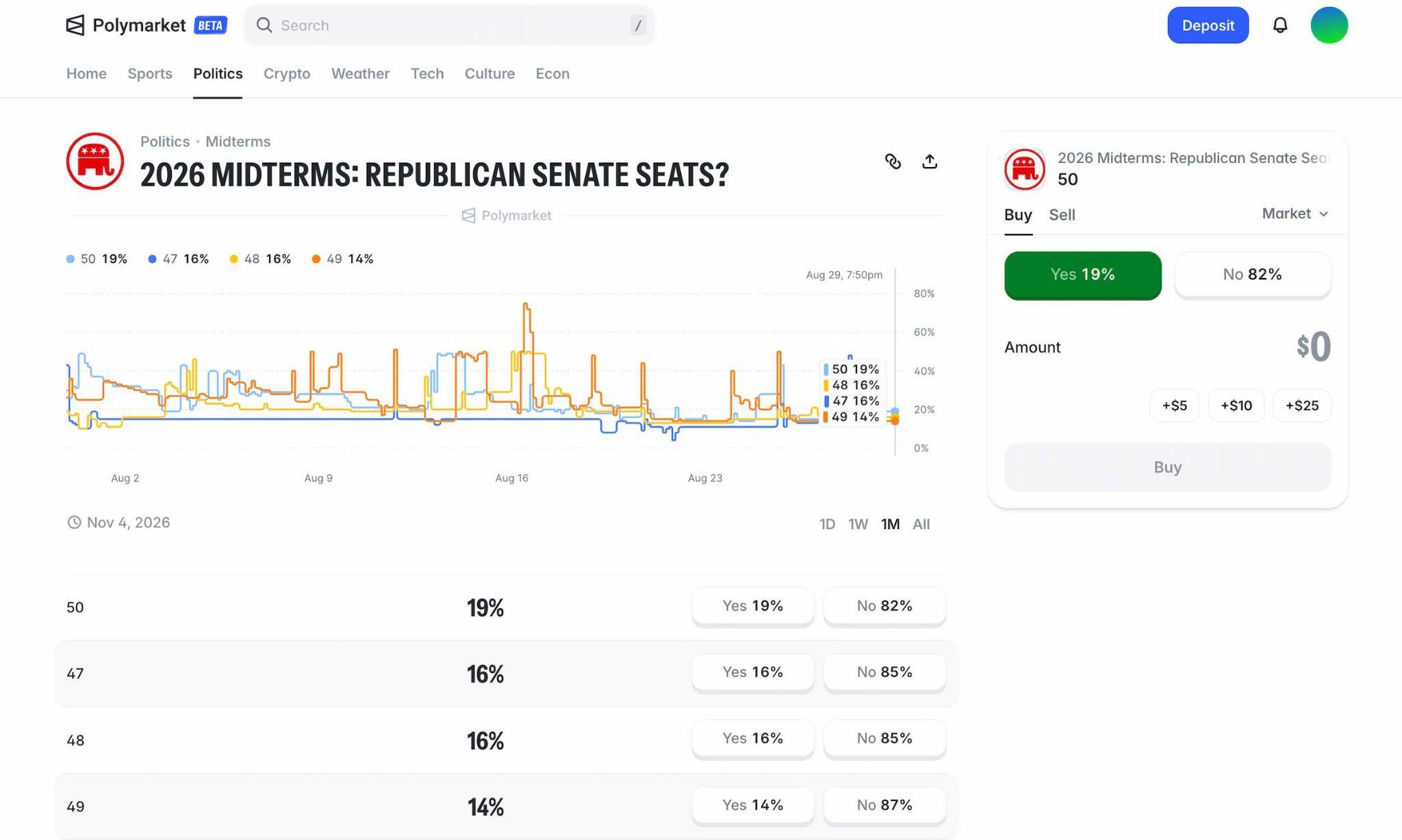
*The image above was captured live on August 29, 2026, and is subject to change.
Polymarket US runs its politics markets through QCX LLC, a separate CFTC-regulated exchange the company acquired to bring election contracts onshore for US residents. That’s worth knowing up front, since Polymarket’s original international site also lists House and Senate markets that US users cannot legally access.
For the midterm election, Polymarket US covers House control, Senate control, individual Senate and governor races, and House balance-of-power combinations. Its two headline contracts keep pace with Kalshi on volume, with over $10 million traded on the House control market alone, though coverage thins out on smaller down-ballot races.
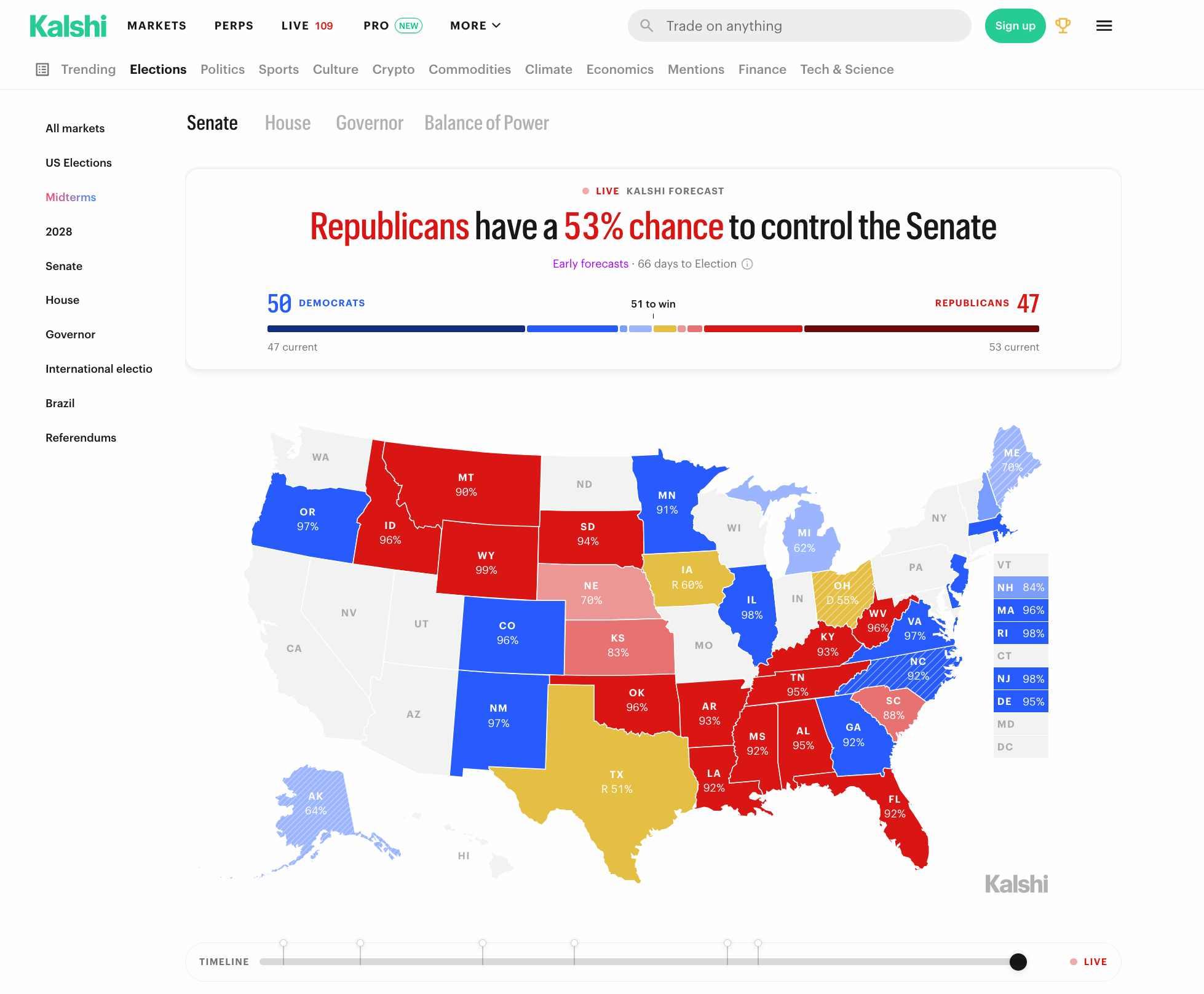
Right now, Polymarket US prices the House at 85% Democratic and the Senate at 52% Republican and 46% Democratic, a snapshot worth checking again since these prices can move fast this close to the election.
Pros:
- CFTC-regulated venue built specifically for US election trading
- Funding flexibility, including on-chain USDC deposits (crypto values can fluctuate)
- Keeps pace with Kalshi on both headline control markets
Cons:
- Thinner coverage of individual House districts and smaller state races
- Easy to land on Polymarket’s international site by mistake, which US residents can’t use for these markets
Kalshi Midterm Election
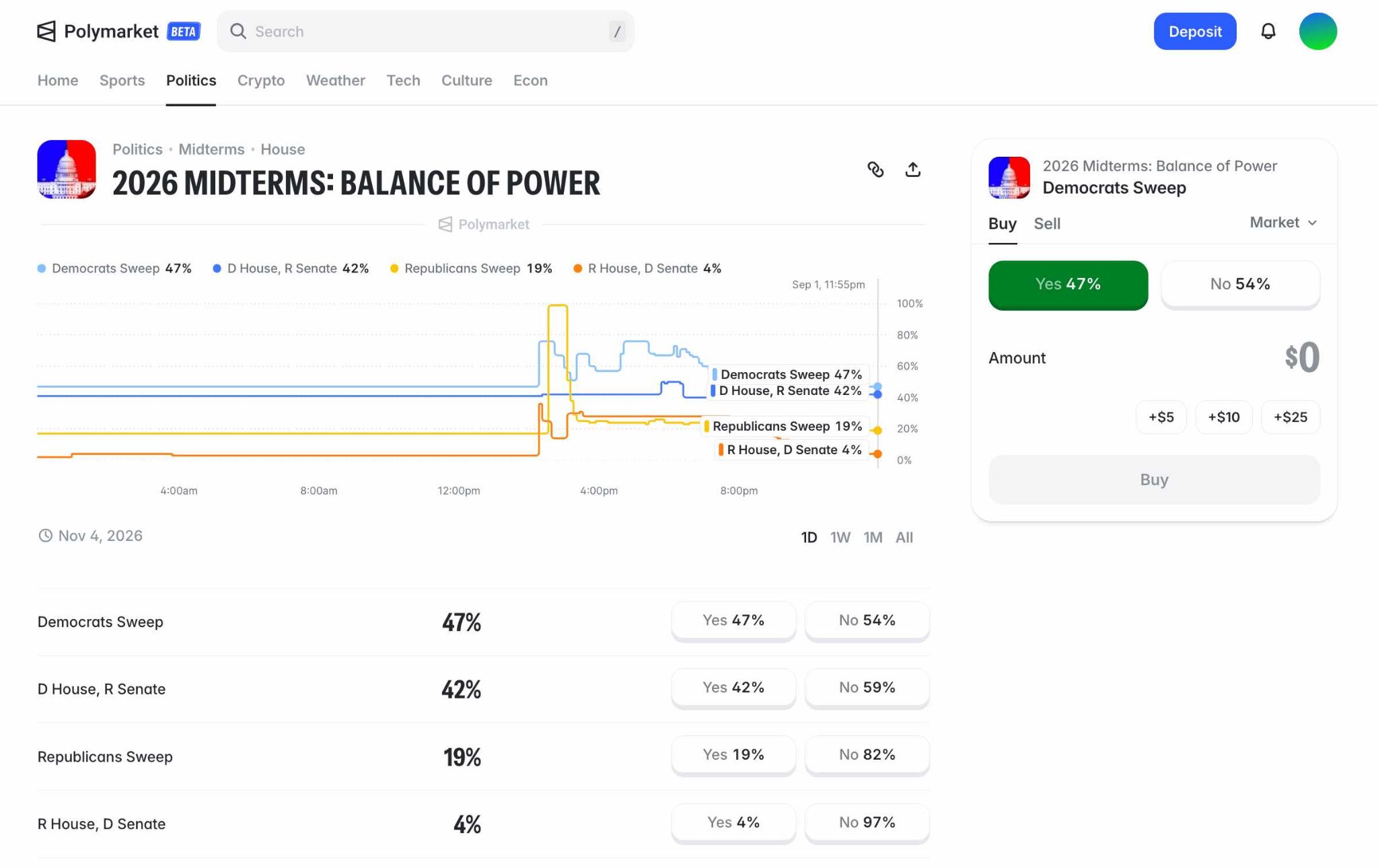
*The image above was captured live on August 29, 2026, and is subject to change.
Kalshi runs its own CFTC-registered exchange from the ground up rather than routing through a separate acquired entity and organizes its entire midterm slate under one Elections tab with House, Senate, and Governor subcategories.
Kalshi lists more individual midterm markets than Polymarket US does. Its “Which party will win the US House?” market has traded over $31 million, its “Which party will win the US Senate?” market has traded over $11 million, and its separate Midterms: Congress Balance of Power combo market has traded over $11 million of its own.
Beyond the two chamber-control markets, Kalshi also lists individual contracts for dozens of House districts and the most competitive Senate and governor races.
Right now, Kalshi prices the House at 85% Democratic to 15% Republican and the Senate at 53% Republican to 47% Democratic, a notably tighter Senate price than Polymarket US is currently showing.
Pros:
- Contracts on dozens of individual House districts, plus the closest Senate and governor races
- One easy-to-browse Elections tab covering the whole midterm map
- Straightforward ACH funding for US bank accounts
Cons:
- No option to fund with crypto if that’s your preference
- Same fee exposure as Polymarket US on every contract, so depth doesn’t mean cheaper trading
Polymarket vs Kalshi: Key Differences
| Polymarket US | Kalshi | |
| House control price | 85% Democratic | 85% Democratic |
| Senate control price | 52% Republican / 46% Democratic | 53% Republican / 47% Democratic |
| House market volume | Over $10 million | Over $31 million |
| Funding options | Bank transfer or USDC (crypto values can fluctuate) | Bank transfer (ACH) |
| Regulator | CFTC, via QCX LLC | CFTC, direct |
*Live prices as of 14:00 GMT on August 29, 2026.
So which one should you trust? Right now, the two platforms actually agree: both currently have Republicans slightly favored to hold the Senate, Kalshi at 53% and Polymarket US at 52%, close enough that either could flip on a single news cycle. Which platform you lean on says more about how you want to fund your account and how deep you want to go on individual races than it does about either platform being objectively right.
Both charge a fee, just structured differently. Kalshi adds its fee to the contract price,while Polymarket US charges a taker fee that peaks at $1.50 per 100 contracts on a market priced near $0.50 and falls away toward either end of the board, with a small rebate for orders that rest on the book. Check each platform’s current schedule rather than assuming the two work the same way.
Resolution rules matter just as much as price, and the two platforms get to the same place by different routes. Kalshi’s House control market is determined by the party identification of the Speaker of the House on February 1, 2027. Polymarket US resolves on the majority of the chamber’s voting seats, and only falls back to the Speaker’s party if no party wins an outright majority. Its resolution sources are official information from state electoral authorities, the United States Congress, and a consensus of credible reporting, rather than any single network call. Where a seat is decided by a runoff, Polymarket US attributes that seat by the runoff result, so the contract stays open rather than settling early. Read each market’s own rules page before you trade: the wording differs market by market, even on the same platform.
One more overlap worth knowing: neither platform accepts users in Nevada at present, where the Nevada Gaming Control Board won a temporary restraining order against Kalshi, later extended into a preliminary injunction requiring the platform to geofence the state, and the same court granted the Board a separate injunction blocking Polymarket US. Both restrictions are still in force. Beyond that, it really does come down to what you value more. The number of individual races Kalshi lists, or Polymarket US’s funding flexibility, and the table above are the best starting points for making that call yourself.
How do Midterm Elections Markets Work on Prediction Apps
The Basic Mechanics
If you’ve never traded a contract tied to US midterm odds before, the mechanics are easier than they look. Every market asks a single yes-or-no question about a real event, like “Will the Republican Party win the US House?” You buy shares in whichever outcome you think will happen. If you’re right, each share settles at $1. If you’re wrong, it settles at $0. There is no partial settlement in between.
Turning a Price Into a Payout
The share price is the market’s implied probability. A “yes” contract trading at $0.65 implies that traders collectively assign an implied probability of roughly 65% to that outcome. To turn that price into what you’d actually make, subtract the price from $1: buy 100 shares at $0.65 for $65, and a correct call pays out $100, a $35 profit before fees.
Get it wrong, and the $65 you paid is gone. That’s the whole payout structure: no separate odds of midterm elections format to convert, and the exchange isn’t taking the other side of your trade. If you came here searching for midterm betting odds, that is the difference to hold onto: a betting site quotes odds and takes the other side of your stake, while a prediction market quotes a contract price set by other traders.
Fees, Selling Early, and Resolution
Fees eat into that math on both sides. Per Kalshi’s fee schedule, 100 contracts bought at $0.65 cost exactly $1.60 in trading fees, on top of the $65 you paid. The same 100 contracts at $0.65 on Polymarket US cost $1.36, deducted from your balance the moment your order matches. That fee applies whether you’re trading the headline House and Senate contracts or a smaller state-level trade, so don’t expect a thin midterm market to be fee-free just because volume is light.
You don’t have to hold a contract until it resolves, either. Both platforms let you sell out of a position at the current price any time before settlement, though the gap between the buy and sell price can widen on thinner markets. These control markets don’t settle on election-night projections. Polymarket US resolves on official seat counts from state electoral authorities and Congress, and Kalshi’s House and Senate control markets run to February 1, 2027, when the new Congress has organized and chosen its leadership. That’s why a contract can stay open for weeks or months after election night while a recount, a runoff, or a caucus decision plays out.
Trading Multi-Outcome Races
For something like Senate control, where the options are more than a simple two-way split, both platforms let you trade the specific combination you think will happen, say, a Democratic House paired with a Republican Senate, rather than forcing a single trade on the whole outcome.
Kalshi packages this as a single combo market with several outcomes priced side by side; Polymarket US lists it as a multi-outcome event where each combination is its own tradeable line. The mechanics are the same underneath: you’re pricing one specific 2026 midterm outcome, not trading on a simple two-way race.
Pivotal 2026 Midterm Election Prices and Predictions
Here’s what the two platforms are pricing in for the 2026 midterms right now. If you searched for 2026 midterm election odds, these tables are the contract prices behind that number, heading into the final stretch before Election Day.
Which Party Will Win the US House?
Polymarket US Prices

*Live prices from Polymarket US as of 22:00 GMT on September 1, 2026.
Kalshi Prices
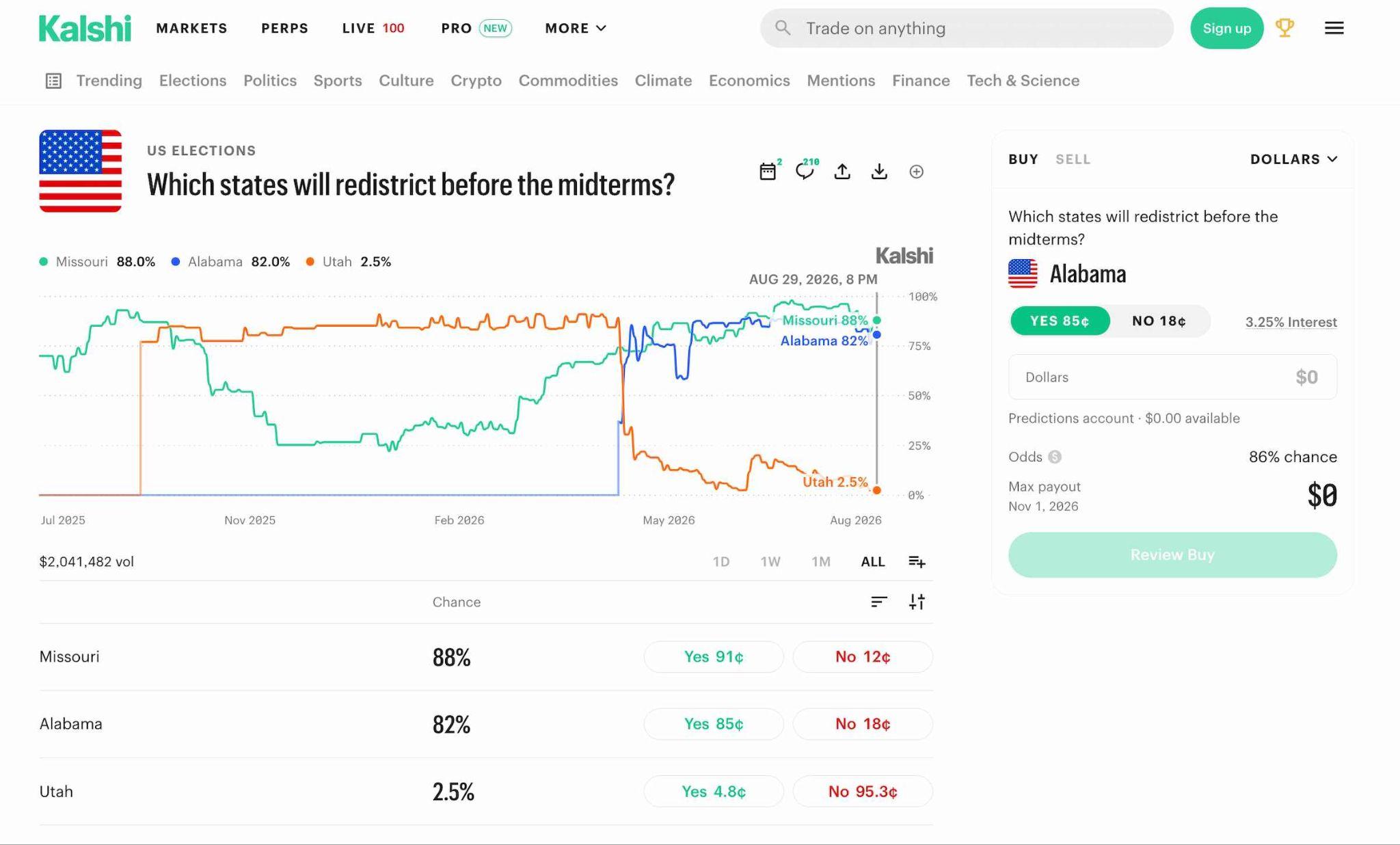
*Live prices from Kalshi as of 22:00 GMT on September 1, 2026.
| Prediction Market Apps | Democratic | Republican |
| Polymarket Prices | (Yes) 85% /(No) 15% | (Yes) 17% /(No) 83% |
| Kalshi Prices | (Yes) 85% /(No) 15% | (Yes) 15% /(No) 85% |
*Live prices as of 22: 00 GMT on September 1, 2026, and are subject to change. Check each app directly before you trade, and look at the volume behind a price, not just the headline number, before deciding how much weight to give it. These are the 2026 House control prices specifically; scroll down for the Senate and governor breakdowns.
Both platforms price a Democratic House at 85%, and they’ve barely moved apart despite pricing the race through two completely separate platforms. That kind of agreement usually means the underlying signal, in this case, a Republican majority thin enough that a handful of seats flipping ends it, is being read the same way by two different pools of traders.
Brookings’ own midterm research points to why: the president’s party has lost House seats in 20 of the last 22 midterms since 1938, and this market’s price is roughly in line with that historical base rate rather than pricing in anything unusual. It’s a good reminder that prices for midterm elections tend to track real political history, not just headlines.
Trading event contracts carry risk. Prices move with the market, and you can lose the full amount you pay for a contract, including fees. Past performance is not indicative of future results, and Trading is not suitable for everyone.
Balance of Power / Trifecta

| Outcome (Kalshi combo) | Price |
| Democratic House, Democratic Senate | 47% |
| Democratic House, Republican Senate | 39% |
| Republican House, Republican Senate | 16% |
| Republican House, Democratic Senate | 1% |
*Live prices as of 14:00 GMT on August 29, 2026, from the Kalshi Platform, and subject to change.
Polymarket US runs the exact same combination market under its own Balance of Power listing, and the board there tells a similar story with slightly different numbers:
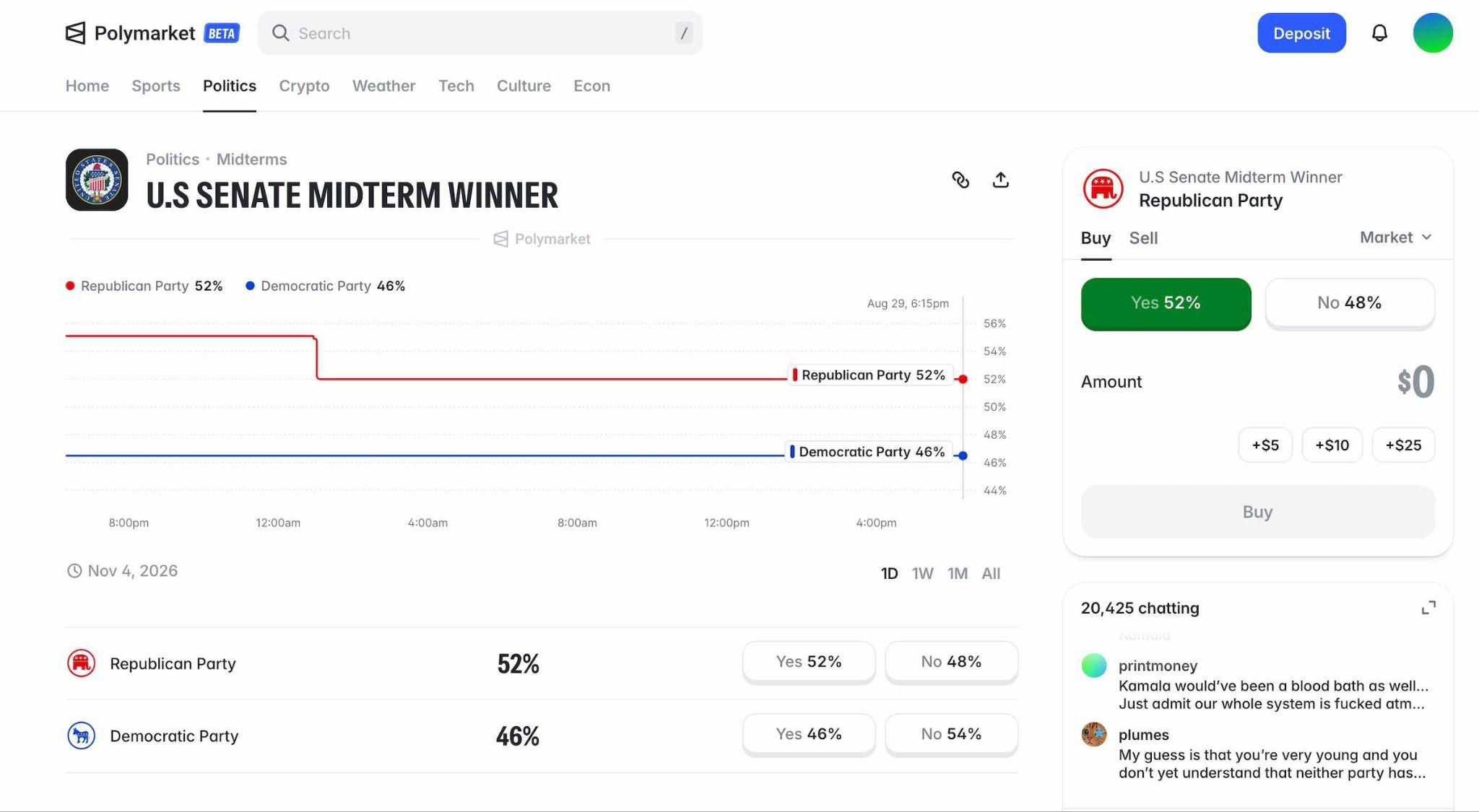
| Outcome (Polymarket combo) | Price |
| Democratic House, Democratic Senate | 47% |
| Democratic House, Republican Senate | 42% |
| Republican House, Republican Senate | 19% |
| Republican House, Democratic Senate | 4% |
*Live prices as of September 1, 2026, from the Polymarket US platform, and subject to change.
A full Democratic sweep of Congress is the single most likely outcome on both platforms, but only by a margin over a split Congress with a Republican Senate and a Democratic House. On Kalshi, add those two leading outcomes together, and Democrats hold the House roughly 86% of the time regardless of what happens in the Senate, which lines up with the standalone House price above. Polymarket US prices that same combined outcome even higher, close to 89%, which matches its own standalone House number too.
The real argument on this isn’t about the House on either platform. It’s about whether Republicans can hold the Senate, and that’s tight enough to matter. Where Kalshi and Polymarket US diverge a little is on the tails: Kalshi prices a full Republican sweep at 16% against Polymarket US at 19%, and a Republican House paired with a Democratic Senate stays a longshot on both, just 1% on Kalshi and 4% on Polymarket US.
Which Party Will Control the US Senate?

| Prediction Market App | Democratic | Republican |
| Kalshi | 47% | 53% |
| Polymarket US | 46% | 52% |
*Live prices on August 29, 2026, and are subject to change.
This is the market that flipped for the first time this cycle, with over $11 million in volume on Kalshi’s Senate control market alone. A year ago, Republicans were priced to take the chamber. That gap has closed to a near coin flip, largely on the back of a handful of individual races (Texas, Ohio, and Alaska among them) tightening at the same time.
If you’re weighing which side of this contract to take, the closest individual state races below are doing most of the work behind this headline number.
Closest Senate Races

| State | Leading candidate | Price | Trailing candidate | Price |
| Texas | Ken Paxton (R) | 50% | James Talarico (D) | 50% |
| Ohio | Sherrod Brown (D) | 55% | Jon Husted (R) | 45% |
| Iowa | Ashley Hinson (R) | 59% | Josh Turek (D) | 41% |
| Michigan | Abdul El-Sayed (D) | 62% | Mike Rogers (R) | 38% |
| Alaska | Democratic party | 62% | Republican party | 38% |
| Maine | Troy Jackson (D) | 65% | Susan Collins (R) | 35% |
| Georgia | Jon Ossoff (D) | 76% | Mike Collins (R) | 24% |
*Pulled straight from the live Kalshi boards at 16:00 GMT on August 28, 2026, and they are subject to change. Also note that this table only lists Kalshi’s prices; Polymarket US doesn’t currently break out individual Senate races this way.
Texas is the one to watch. Kalshi has Ken Paxton at 50% against James Talarico at 50%, an equal price that would have been unthinkable in a state that hasn’t sent a Democrat to the Senate since 1988. A late scandal-driven slide for Paxton, paired with a genuine fundraising surge for Talarico, is what pulled this from a comfortable Republican hold into a coin flip over the summer.
Worth a mention here. North Carolina, floated as a potential nail-biter earlier in this cycle, has settled into safer territory, with Kalshi pricing Roy Cooper at 92.7% at that same 16:00 GMT snapshot. Georgia has drifted the same way: at 76% for Jon Ossoff, it is the widest gap left on the table above. The seven races listed there are the ones actually moving the price above, so they’re the ones worth watching as Election Day gets closer.
Closest Governor Race

| State | Leading candidate | Price | Trailing candidate | Price |
| Ohio | Amy Acton (D) | 56% | Vivek Ramaswamy (R) | 45% |
| Georgia | Keisha Lance Bottoms (D) | 59% | Rick Jackson (R) | 40% |
| Iowa | Rob Sand (D) | 75% | Zach Lahn (R) | 27% |
| Michigan | Jocelyn Benson (D) | 51% | John James (R) | 47% |
| Wisconsin | David Crowley (D) | 53% | Tom Tiffany (R) | 45% |
| Arizona | Katie Hobbs (D) | 55% | Andy Biggs (R) | 43% |
*Pulled straight from the live Kalshi boards at 18:00 GMT on August 29, 2026, and is subject to change. This table only lists Kalshi’s prices; Polymarket US doesn’t currently break out a governor race this way.
Michigan is the tightest race on this board. Jocelyn Benson sits at 51% against John James at 47%, close enough that a single week of movement could flip the lead, in an open seat left by a retiring Democratic incumbent. Wisconsin is the next closest, with David Crowley at 53% to Tom Tiffany’s 45%, also an open seat after a Democratic incumbent chose not to run again.
Ohio’s open-seat race is the third tightest, and it’s the one carrying the most historical weight. Amy Acton is priced at 56% against Vivek Ramaswamy’s 45% in a state that hasn’t elected a Democratic governor since 2006, so the market has her ahead without pricing it as comfortable.
The situation with Iowa is surprising. Rob Sand is priced to win in a state Donald Trump carried by roughly 13 points in 2024, which tells you more about how this particular matchup has developed than about any broader shift in the state’s lean.
California’s governor race, by contrast, isn’t close at all. Polymarket US prices Xavier Becerra above 97%, making it one of the most lopsided marquee races on the entire midterm map.
Arizona rounds out the competitive group, where Katie Hobbs is running for re-election at 55% against Andy Biggs at 43%. Taken together, the three Democratic-held governorships Trump carried in 2024: Michigan, Wisconsin, and Arizona are the states worth watching, with Michigan and Wisconsin the two closest races on the table and Arizona sitting just behind Ohio. None of these governor markets move the congressional control prices directly, but they’re a useful check on how individual states are breaking this cycle
Closest House Races

| District | Leading candidate | Price | Trailing candidate | Price |
| CA-07 | Doris Matsui (D) | 55% | Mai Vang (D) | 49% |
| WI-03 | Rebecca Cooke (D) | 58% | Derrick Van Orden (R) | 41% |
| OH-09 | Marcy Kaptur (D) | 53% | Republican Party | 46% |
| AZ-06 | Democratic Party | 51% | Juan Ciscomani (R) | 48% |
| PA-10 | Democratic Party | 50% | Scott Perry (R) | 49% |
| NE-02 | Democratic Party | 54% | Don Bacon (R) | 45% |
*Pulled straight from the live Kalshi boards at 19:00 GMT on August 29, 2026, and is subject to change. Polymarket US lists contracts on a smaller, selected group of House districts rather than the full competitive map, so not every district here has a matching Polymarket US market.
Unlike the Senate and governor maps, the House isn’t decided by a handful of marquee names. Kalshi alone lists individual contracts on dozens of competitive districts, and more than five are trading closely enough that neither party is priced above 75% at the time of writing.
If you want to trade a single district rather than the national House control market, search each platform directly by state; the closest seats shift from week to week as fundraising reports and late endorsements land, more than any of the statewide races above.
Note: If national control is what you care about most, the House and Balance of Power tables above already capture the 2026 midterm prices that matter.
Other Midterm Election Markets
Beyond the headline control and race-level markets already covered, a few other contracts round out the 2026 midterm markets board.
Democratic vs Republican Seat Count

**Pulled straight from the live Polymarket US at 19:00 GMT on August 29, 2026, and is subject to change.
Both platforms also list seat-count contracts: ranges like “Democrats win 218 to 222 House seats” that pay out based on the final seat total rather than which party simply holds the majority. These have moved in the same direction as the House and Senate control markets above, toward a bigger expected Democratic House gain than traders were pricing at the start of the year, and toward Republicans defending a narrower Senate margin than most expected heading into 2026.
Historically, these seat-count contracts have traded thinner than the simple control markets, since they require picking a specific range rather than just a winner, so expect wider spreads if you go looking for one. If you want more granular exposure than the headline control markets offer, this is where to look, but check the volume on a specific range before assuming the price reflects a deep, liquid market. Think of this as a more precise cut of the same implied probabilities already priced into the simple control markets.
Redistricting
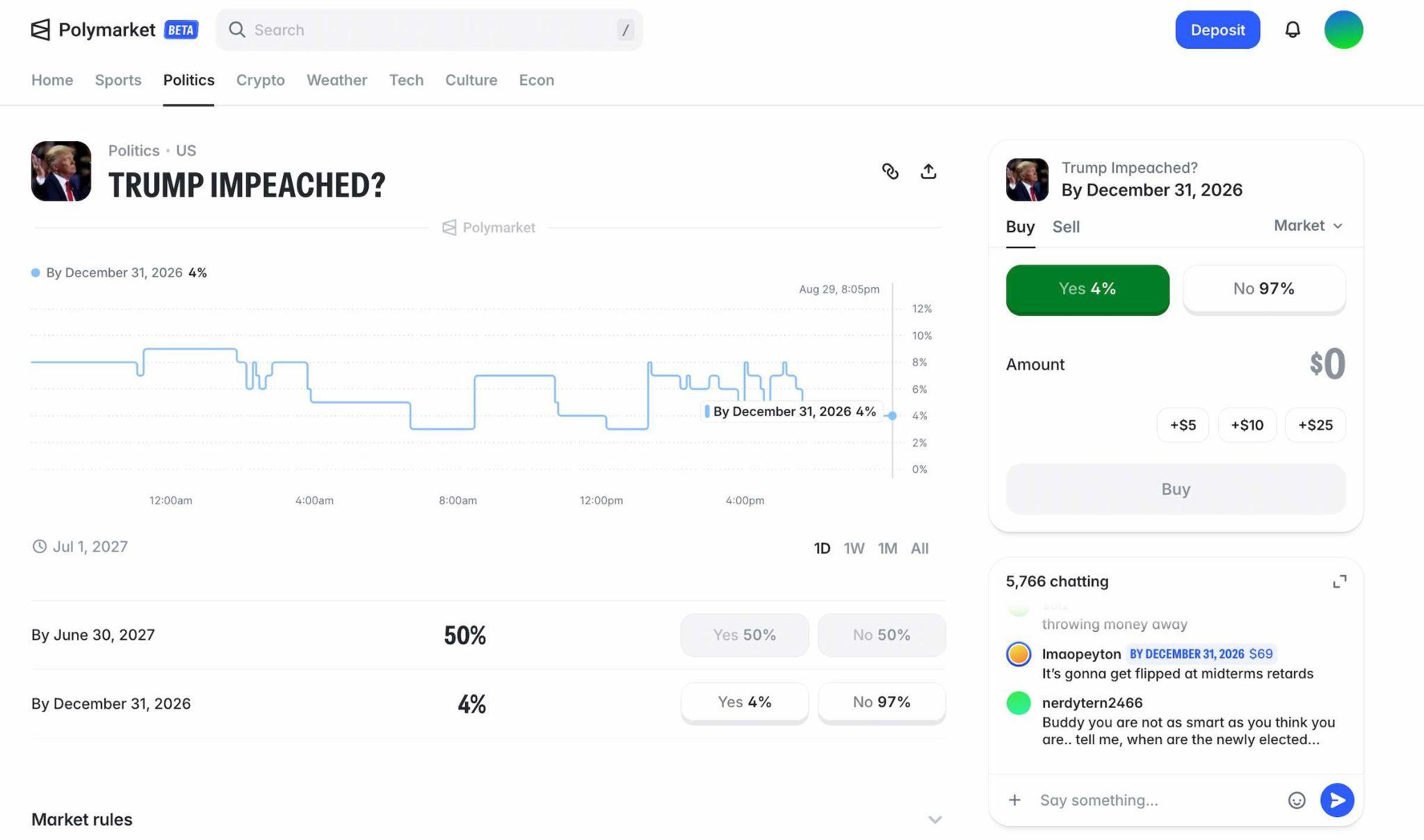
**Pulled straight from the live Kalshi at 20:00 GMT on August 29, 2026, and is subject to change.
The mid-decade Texas and California map fights are the defining structural story of this House cycle. Texas Republicans redrew the state’s congressional boundaries mid-decade to shore up several competitive seats ahead of 2026, and California responded with its own mid-decade redistricting push to offset that advantage. Both efforts faced legal challenges over the first half of the year.
Neither platform runs a market on the legal fight itself, but the redrawn maps are baked into the prices of individual districts. A seat that looks safely Republican or safely Democratic, based on how it used to be drawn, may still be priced in a legal challenge that hasn’t fully played out. That’s part of why prices in individual districts can look surprising compared to a district’s past voting history.
Generic and Trump Approval Markets
*Pulled straight from the live Polymarket US at 20:00 GMT on August 29, 2026, and is subject to change.
Kalshi runs a series of running contracts on President Trump’s approval rating, refreshed on a rolling basis and verified against public polling averages rather than a single pollster’s results. These aren’t midterm contracts themselves, but they’re some of the most closely watched leading indicators on the platform, since a president’s approval rating has historically tracked closely with how badly the president’s party performs in a midterm.
Polymarket US runs a similar slate of Trump-specific contracts, and they are a good example of how much the attached timeframe changes a price.
Ask whether Trump leaves office before 2027 and the market prices it as very unlikely. Ask whether he is impeached at any point before his term ends in January 2029, and the price sits far higher, because that version gives Democrats years to retake the House and act on it. Narrow the same question to the end of 2026 and it drops back down, since it would need House Republicans to turn on the president within months. Same underlying event, three very different prices, because each contract trades on the calendar as much as the politics.
There’s no standalone “generic ballot” contract on either platform, at least not the way pollsters define it, but the House and Senate control prices above are effectively pricing in the same signal. Together, approval trends and midterm contract prices tend to move in the same direction, even though they’re priced on entirely separate markets.
Other Politics Prediction Prices Available
The midterms aren’t the only political markets available to US users on Polymarket US and Kalshi. A few other categories are worth knowing about if you’re curious beyond November, none of which count toward the 2026 midterm prices discussed above:
- Next French presidential election (2027): Kalshi lists a full field of contracts on France’s next presidential race, including who makes the ballot and who ultimately wins, more than a year out from the vote itself. It’s an example of how far in advance these markets open, well before most US traders would think to look.
- Brazilian presidential politics: Kalshi offers a dedicated Brazil elections category alongside its broader international elections section, allowing US users to trade on a major Latin American race without needing a separate account elsewhere.
- UK and European elections: Both platforms periodically list contracts tied to major European votes as campaigns develop, filed under their broader international elections categories, though coverage and liquidity vary a lot by country and by how close the vote is.
- Next Federal Reserve Chair: A closely watched non-midterm political contract, since the appointment carries direct market-moving weight for interest rates and the broader economy, not just political bragging rights.
- 2028 presidential primary fields: Both platforms already list active markets on the next Democratic and Republican presidential nominees, years ahead of the actual primaries, reflecting how quickly attention (and trading volume) shifts to the next cycle.
Midterm Election Odds FAQs
- Is betting on the US Election Legal?
No. Traditional sports-style betting on US elections is illegal in every state. What is legal, and regulated by the Commodity Futures Trading Commission, is trading event contracts on regulated exchanges like Kalshi and Polymarket US, where you’re buying and selling a financial contract tied to an outcome rather than placing a stake with a bookmaker. So if you are searching for 2026 midterm betting odds, what these platforms actually publish are contract prices, not bookmaker odds.
- Is trading midterm election odds legal in my state?
For most states, yes, since Kalshi and Polymarket US operate as CFTC-regulated exchanges under federal oversight. Nevada is the clear exception right now: both platforms currently restrict or have restricted election-related contracts there amid ongoing state litigation. A few other states have pursued their own challenges, so it’s worth confirming eligibility in the app itself before you deposit any money.
- What types of US midterm elections prediction markets can I trade on Polymarket?
On Polymarket US specifically, you can trade contracts on House and Senate control, individual Senate and governor races, House balance-of-power combinations, and seat-count ranges for both chambers. Just make sure you’re on the US-regulated platform rather than Polymarket’s international site, which US residents cannot use for these markets.
- What is the current top US midterm election prediction?
Right now, the most closely watched question is which party will control the US Senate and House after the 2026 elections. The House is priced as a likely Democratic pickup on both platforms, while the Senate sits close enough to a coin flip that it’s genuinely competitive, and that’s really what all of the 2026 midterm prices above reflect.
- Why use a predictions market app 2026 midterm predictions?
A regulated prediction market gives you a real-time, real-money read on an election that updates the moment new information lands, rather than a poll that’s already a few days old by the time it’s published. Because real money is on the line, traders have a direct incentive to update their positions fast when a poll, a debate, or a scandal breaks, which is part of why these prices sometimes move ahead of the news cycle rather than just reacting to it. That doesn’t make either platform a crystal ball, and prices can move sharply on a single piece of news, but it’s a different, faster kind of signal than traditional polling alone.
- Can I track midterm election predictions without trading?
Yes. Both Kalshi and Polymarket US let you view live prices on every market without creating an account or funding anything, so you can follow the market prices purely as a spectator if you’d rather not trade.
- What’s the difference between Kalshi (CFTC-regulated exchange) and Polymarket?
Kalshi is a CFTC-regulated exchange built from the ground up as a US derivatives market. Polymarket started as an international, crypto-funded platform and later launched Polymarket US, a separate CFTC-regulated exchange for US residents, alongside its original global site. For midterm election contracts specifically, stick to Polymarket US rather than the international platform; see the full comparison above for how their prices, fees, and coverage stack up.
- Are profits from event contracts taxable?
Yes. Profits from event contract trading are generally taxable income in the US, and Kalshi issues tax documents to eligible users each year. Exact treatment can depend on your personal situation, so it’s worth checking with a tax professional rather than assuming a flat rate applies.



