


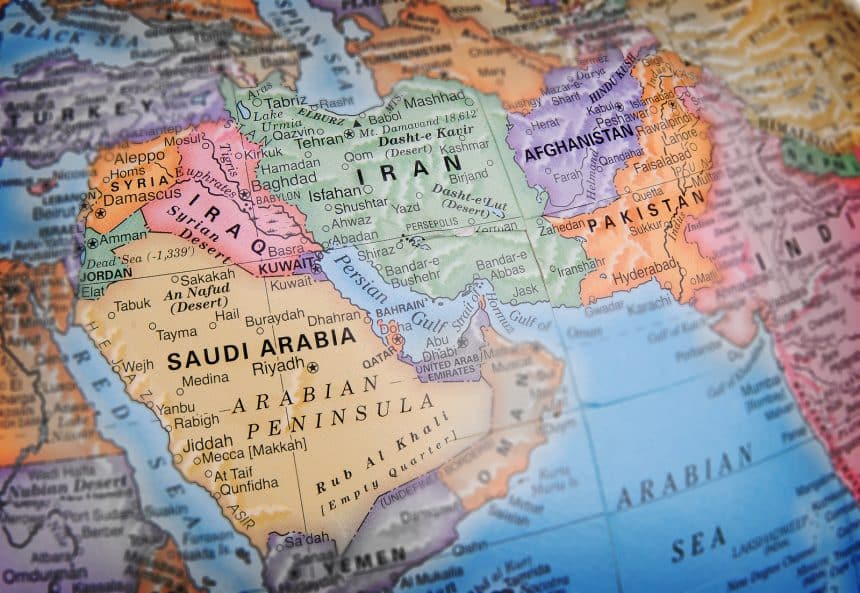
A massive military escalation is unfolding in the Middle East as Iran’s Islamic Revolutionary Guard Corps (IRGC) launched a coordinated, three-phase missile and drone assault targeting U.S. military bases in Bahrain, Kuwait, and Jordan. The retaliatory strikes follow consecutive nights of heavy U.S. airstrikes inside Iran and a newly declared maritime blockade of the Strait of Hormuz by President Donald Trump. As global oil prices surge, international authorities are warning of a rapid spiral into regional war.
MIDDLE EAST – July 14, 2026 (STL.News) The Middle East is experiencing an intensely volatile military escalation. Following the collapse of the short-lived June ceasefire memorandum of understanding (MoU), hostilities have reignited with unprecedented force.
Iran’s Islamic Revolutionary Guard Corps (IRGC) executed a series of coordinated, long-range missile and drone strikes across several Gulf and neighboring nations. The operation—dubbed “eye-for-an-eye” by Tehran—was launched in direct response to heavy U.S. Central Command (CENTCOM) bombardments along Iran’s southern coastlines.
Middle East – Coordinated Retaliation: The Three-Phase IRGC Strikes
According to statements released by the IRGC’s official outlet, Sepah News, the Iranian retaliatory operation targeted critical U.S. military infrastructure in three distinct phases:
- Phase 1 (Jordan): The IRGC targeted the Prince Hassan Air Base with ballistic missiles and suicide drones, claiming to have ignited large ammunition storage facilities and fuel depots.
- Phase 2 (Bahrain): Strikes focused on the Sheikh Isa Air Base, a vital hub for the U.S. Navy’s Fifth Fleet. The IRGC claimed hits on helicopter maintenance facilities, drone command-and-control centers, and a hangar housing a P-8 Poseidon surveillance aircraft.
- Phase 3 (Kuwait): Aerospace forces targeted the Ali Al-Salem and Ahmed Al-Jaber airbases, claiming to have ” helped destroy” Patriot missile defense batteries, fuel reserves, and a strategic FPS radar installation.
These strikes occurred immediately after CENTCOM completed its third consecutive night of precision airstrikes inside Iran, utilizing fighter jets, naval combatants, and newly deployed one-way sea drones to degrade air defense systems, coastal radar networks, and port facilities in Sirik, Bandar Abbas, and Jask.
The Battle Over the Strait of Hormuz
The primary flashpoint for this rapid escalation is control over the Strait of Hormuz, through which roughly one-fifth of global oil and gas supplies transit.
Over the weekend, the IRGC Navy attempted to halt and seize commercial vessels transiting the strait. In response, President Donald Trump declared that the United States is officially “reinstating” a strict naval blockade exclusively targeting Iranian shipping.
In a major policy shift, President Trump announced that the U.S. will impose a mandatory 20% toll fee on the value of cargo carried by other neutral commercial ships transiting the waterway. The President asserted that the levy would help cover all costs necessary to do the job of providing safety and security to this very volatile section of the world.”
Middle East – De-escalation Signals and Legal Backlash
While the military maneuvers suggest an uncontained war, key diplomatic responses and legal pushbacks indicate a far more complex reality. Behind the explosive headlines, several factors oppose the narrative of a total regional collapse:
1. UN Declares Proposed Tolls Illegal
The United Nations International Maritime Organization (IMO) issued a sharp rebuke of the concept of transit tariffs on international waterways. The IMO formally stated:
“There is no legal basis through which to introduce mandatory tolls simply to transit through a strait.”
The agency urged both parties to respect free transit rights, signaling that the international community is actively resisting the legitimization of either U.S. or Iranian-imposed transit fees.
2. Iran’s Unexpected Negotiation Play
In a surprising diplomatic pivot, Iranian Foreign Minister Abbas Araghchi appeared to agree with President Trump’s logic on social media. Araghchi wrote that whoever secures the Strait of Hormuz should indeed be compensated, asserting that Iran has historically played that role. While Araghchi noted that “20% is of course too much,” he added, “We will be fair.”
Military and economic analysts suggest this counter-offer indicates Iran is using its military leverage not to trigger a total war, but to force the U.S. back to the negotiating table to establish a shared transit or tariff framework.
3. Highly Inflated Battle Damage Claims
Independent military analysts caution that the IRGC’s claims of “destruction” of Patriot systems and U.S. drone hangars are highly exaggerated for domestic consumption. CENTCOM has reported that air defense systems successfully intercepted a significant portion of the incoming Iranian ordnance. While the harassment remains a severe threat to regional stability, the physical capabilities of U.S. forces in the Gulf remain largely intact.



