


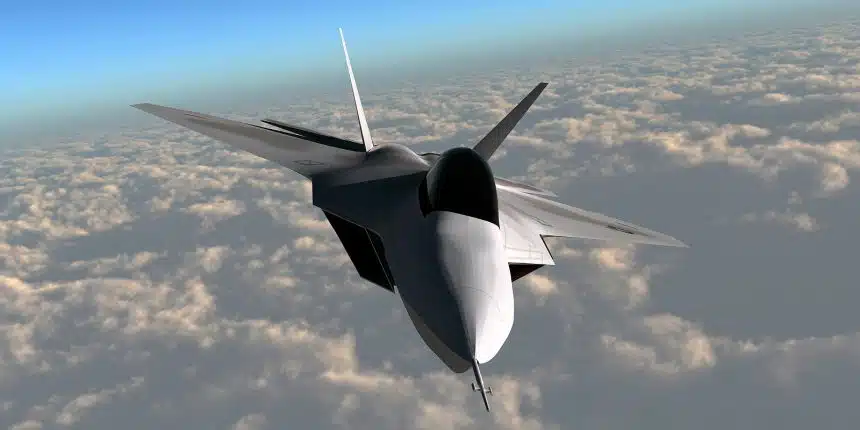
The United States military has begun withdrawing its premier F-22 Raptor stealth fighter jets from Israel’s Ovda Air Base. Despite ongoing tensions and recent U.S. airstrikes against Iranian targets in response to shipping lane disruptions, the dynamic drawdown signals a transition in the Pentagon’s regional force management following the active phase of Operation Epic Fury.
JERUSALEM / WASHINGTON – July 11, 2026 (STL.News) — The United States military has executed a major logistical relocation, pulling a primary squadron of its advanced F-22 Raptor stealth fighters out of Israel. The departure comes at a highly volatile diplomatic juncture, just days after a fragile ceasefire was strained by fresh hostilities in the Strait of Hormuz.
The Logistics of the Drawdown
According to flight-tracking data and regional military correspondents, a squadron of approximately 10 to 12 U.S. Air Force F-22 Raptors departed from the Israeli Air Force’s Ovda Air Base in southern Israel on Friday, July 10, 2026. Accompanied by heavy transport aircraft carrying support equipment and personnel, the advanced air-superiority assets flew to RAF Fairford in the United Kingdom. They are staging at the British facility before completing their transit back to their home installation at Joint Base Langley-Eustis in Virginia.
The F-22 squadron, belonging to the 1st Fighter Wing, initially deployed to Israel on February 23, 2026, ahead of the direct military campaign involving U.S.-led operations against Iranian positions, officially designated as Operation Epic Fury.
The stealth fighters are the latest in a series of top-tier U.S. combat assets rotating out of the Middle East theatre. Just last week, roughly 11 F-15E Strike Eagles from the 492nd Fighter Squadron returned to their home base at RAF Lakenheath after a five-month combat rotation in Jordan. Additionally, several U.S. heavy bombers, including B-1B Lancers and B-52 Stratofortresses, have scaled back their presence at European forward operating hubs.
A Fractured Ceasefire and Shifted Strategy
The redeployment of these high-value airframes coincides with heightened political drama between Washington and Tehran. In mid-June, a 60-day memorandum of understanding was established to secure volatile maritime shipping corridors. However, that agreement has rapidly deteriorated.
Earlier this week, projectile attacks struck three commercial tankers passing through waters near Oman. The U.S. military responded swiftly, launching a massive wave of localized airstrikes hitting more than 170 targets to prevent further disruption to the global energy supply. In a public statement on Friday, the White House signaled that the ceasefire’s active operational terms are effectively over.
Despite the sharp escalation, administration and defense officials emphasize that the physical drawdown of land-based stealth fighters does not represent a retreat from regional security commitments. Instead, it underscores a transition to sustainable force management.
Advanced fifth-generation fighters like the F-22 carry demanding maintenance requirements, specialized equipment footprints, and strict operational thresholds. Stationing them at forward operating bases for nearly five months creates severe logistical strains. Pentagon planners noted that returning these units to standard deployment cycles avoids long-term wear while preserving rapid-response readiness in Europe.
Furthermore, Washington maintains a heavy combat footprint in the immediate region. A significant baseline of land-based USAF fighter squadrons remains active in neighboring territories, heavily reinforced by U.S. Navy assets operating directly from the USS George H.W. Bush carrier strike group.
As technical diplomatic channels remain cautiously open, the visible withdrawal of these premier stealth assets provides U.S. negotiators with structural leverage, demonstrating a willingness to adjust combat postures even as naval and secondary air wings stand ready to enforce regional stability.